{{ 'now' | timezone: 'America/New_York' | date: '%b %d, %Y' }} |
|
|
Welcome back to The Varsity. I’m John Ourand, busily prepping for Thursday’s
sold-out In the Arena sports media conference that we’re hosting with MoffettNathanson. I’ll be onstage to personally interview Adam Silver, Josh Harris, Hans Schroeder, and Jay Marine. Hope to see you there.
We’re just about a month away from Disney’s fourth-quarter earnings call, when we’ll get our first glimpse at how ESPN’s
direct-to-consumer app (don’t call it Flagship!) is actually performing. Until then, we can enjoy the parlor game of guessing how the service is faring. The latest data point: Guggenheim Securities believes the app has added about 500,000 paid subscribers this quarter. Guggenheim also projects that the D.T.C. service will have about 2 million subscribers by the end of FY26.
📣 I would be remiss if I didn’t send out congratulations to Puck’s
exquisitely talented Julia Ioffe, whose soon-to-be-published book on Russia has been shortlisted for the National Book Award. You can order Motherland: A Feminist History of Modern Russia, from Revolution to Autocracy here.
In today’s issue, Julia Alexander puts some numbers against a trend I’ve been following for a while: the rise of athlete-owned media entities. With 158 million Instagram followers, LeBron James can reach more people with the press of a button than any local media outlet that covers his teams. That’s a powerful—and monetizable—point of leverage for the NBA star. Plus: An Antetokounmpo record,
Bill Simmons’ next move, Apple’s NBA plans, and another YouTuber sports rights deal.
Okay, take it away, Julia… |
That’s how many Antetokounmpo brothers will play on the Milwaukee Bucks’ active roster this
season, reportedly setting a record for the NBA. Certainly, there have been brothers on the same team before: Marcus and Markieff Morris, Brook and Robin Lopez, and Goran and Zoran Dragić, to name a few. This year, Steph and Seth Curry will play together
on the Golden State Warriors. But never before have three brothers played on the same team at the same time. Uniting the Greece-born Alex, Thanasis, and Giannis provides a wholesome global narrative that Adam Silver has gotta love—and it certainly doesn’t hurt that it’s happening at the same time the NBA is exploring a European expansion league. |
|
|
A MESSAGE FROM OUR SPONSOR |
Greatness isn't achieved in an instant. It's tested until there is no question — only performance. |
|
|
- Netflix casts Bill Simmons: Netflix’s podcast plans are finally coming to fruition—and Bill Simmons is at the center of them. After endless will-they-or-won’t-they speculation, Spotify and Netflix have entered a non-exclusive partnership that will bring 16 video podcasts—all produced by Simmons’s The Ringer—to Netflix while remaining available on Spotify (but crucially, not made available on YouTube).
Netflix’s interest in sports is now
clear, but the company still has a relatively light slate of live games—leading to the question: How do you keep sports fans engaged if you don’t have actual sports? Docuseries and big events, like the gassy spectacle of the Jake Paul–Mike Tyson boxing match, are one option. Sports-adjacent programming, like WWE, is another. But podcasts are an increasingly big part of most sports fans’ daily diets. As we’ll get into below, there are more than 7
billion views on sports video podcasts on YouTube alone. If Netflix wants a larger piece of the sports streaming pie, teaming up with one of the most popular sports podcasters—and his podcast network—isn’t a bad start. - Apple’s virtual NBA play: I’ve never been one to dismiss Apple’s larger ambitions in streaming—Tim Cook didn’t grow the company to a $3 trillion valuation by wasting money. But it’s hard not to view
Apple’s plans for its Spectrum SportsNet partnership—in which Apple TV will stream a handful of Lakers games next season—as anything other than marketing for its Apple Vision Pro.
Though the first iteration of the virtual reality headset was a bust, Apple’s hardware team has been hard at work on a new model that is expected to be much lighter and less expensive than its current $3,500 offering. And the company rightly views live sports as the perfect use case to demonstrate the full range
of the Vision Pro’s capabilities—giving fans the sensation of sitting courtside, say, or in the driver’s seat of an F1 grand prix. It’s also another sign—along with the rumors that Cook might be succeeded by hardware chief John Ternus—that Apple is renewing its focus on hardware and
further integrating Apple TV with its next generation of products. - Another YouTuber nabs sports rights: Last week, we got yet another example of a digital creator securing sports rights that were once offered exclusively to broadcasters. Zack Nani, a French YouTube creator with more than a million subscribers (and 650,000 on Twitch), landed the rights to 14 U-21 French national team games that will run through the 2027 U-21
Euro. Nani is using these rights, as well as rights he previously secured to a package of Saudi Pro League games for a reported six figures, to create a portfolio of live sports on his channels, including highlight clips on Instagram and TikTok. For smaller leagues looking for the widest audience—especially younger viewers they can convert into lifelong fans—YouTubers might be the best way to reach this generation of cord-nevers.
|
Now, on to the main event… |
|
|
Athlete-owned sports media companies, and video podcasts in particular, have become legit
competitors to the mainstream sports media ecosystem in the fragmented, omni-channel media universe. But have we reached Peak McAfee? |
|
|
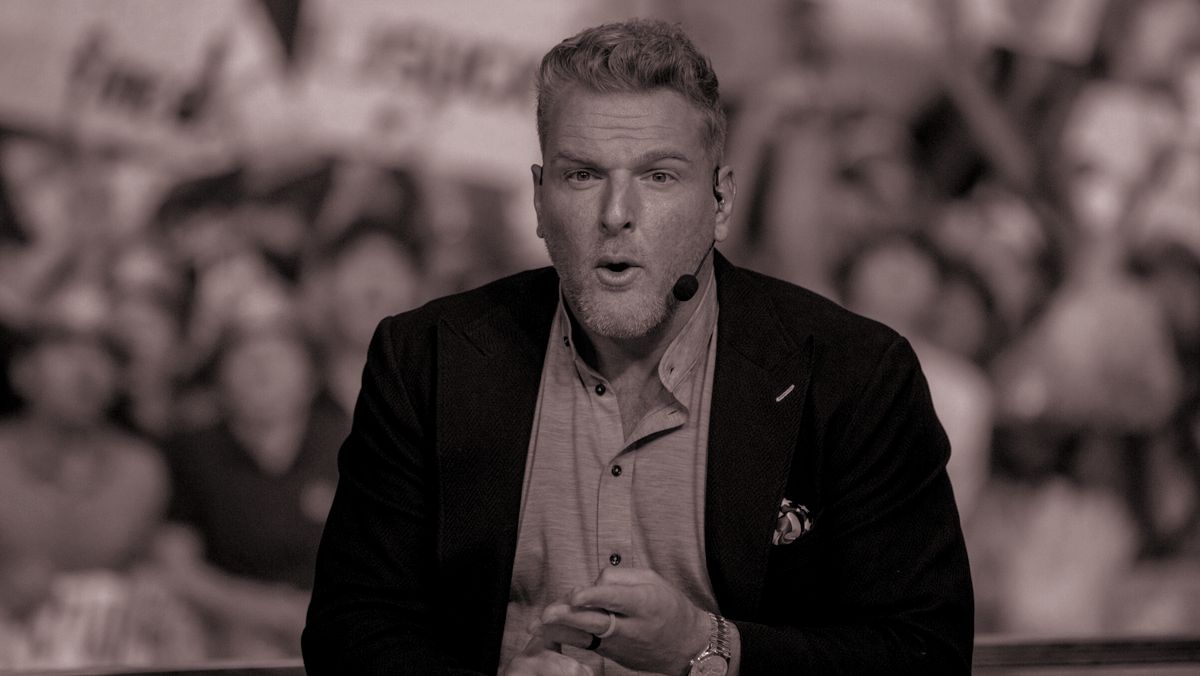
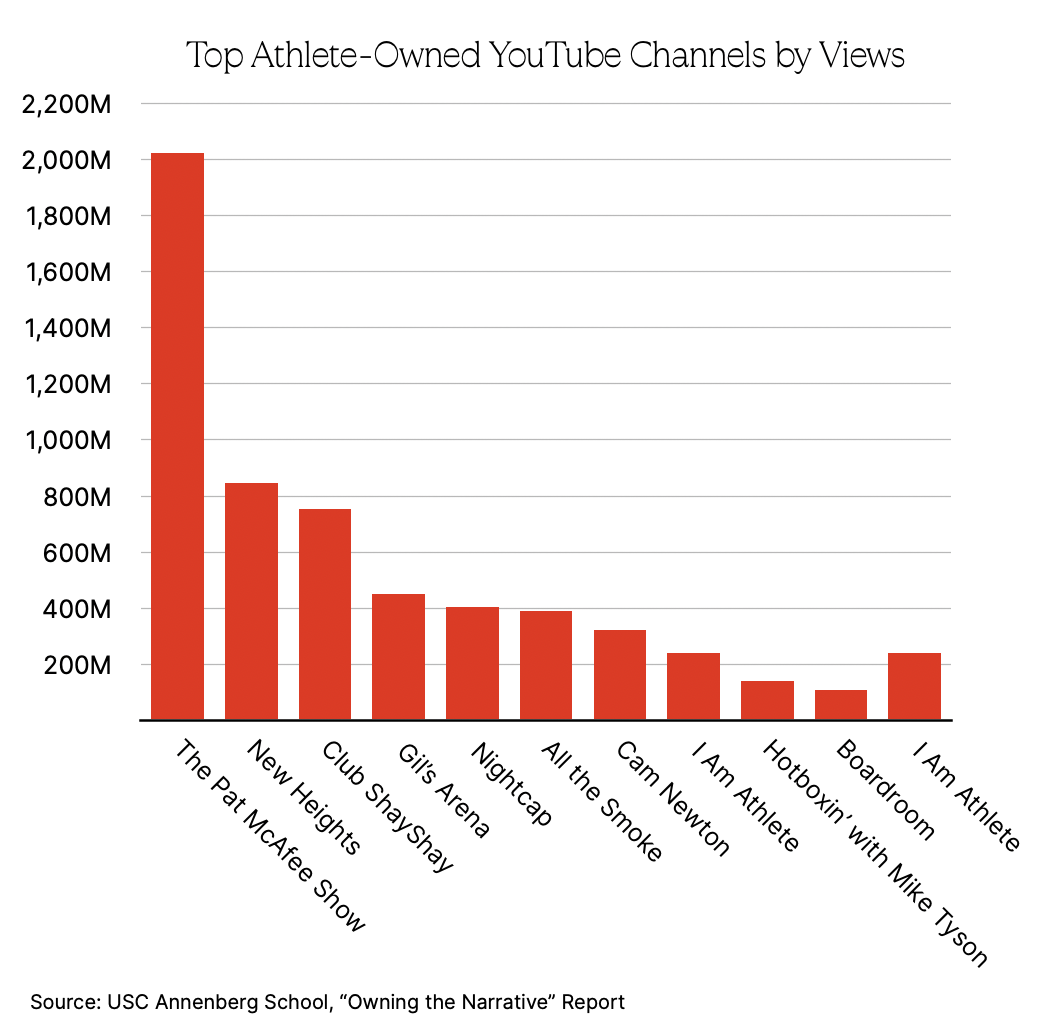
The era of athlete-owned media is upon us, and it’s only accelerating. The success that ESPN has found with
its $85 million investment in Pat McAfee, the shock-(former)-jock business builder, seems to have inspired Fox Sports’s Eric Shanks to secure his own mini-McAfee in Barstool entrepreneur Dave Portnoy. From LeBron James’s SpringHill and Kevin Durant’s Boardroom media companies to Jason and Travis Kelce’s $100 million Amazon deal for their podcast, New Heights, we are
living in the time of the athlete-creator-entrepreneur.
Adam Rogers, director of research at USC Annenberg’s Norman Lear Center, and his team have spent the last year mapping the size and influence of athlete-owned media, analyzing more than 320 properties across sports and formats. Rogers told me he estimates that this burgeoning sub-industry is already worth billions of dollars, with the top podcasts generating more than 7 billion YouTube views, 725 million TikTok
likes, and 37 million Instagram followers combined.
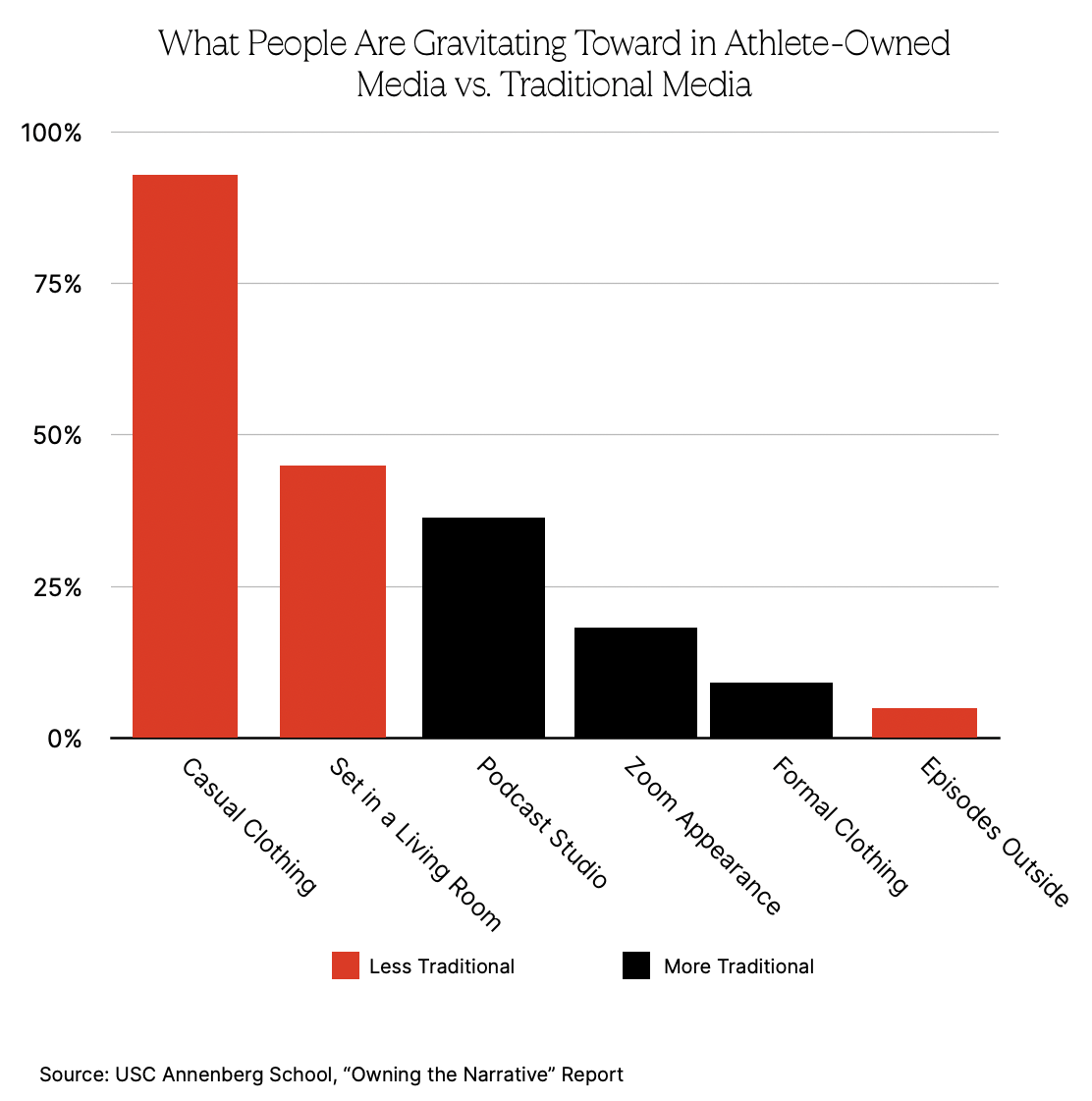
Most of Rogers’s subjects said they viewed themselves as complementary to the traditional sports media ecosystem, not competitors. But there’s no question that many of them have become legit rivals for viewers’ attention, especially in a fragmented, omni-channel media universe where authenticity and access have become needle-movers. There’s nothing like seeing superstar athletes debriefing games on their own terms—suit
jackets swapped out for sweatshirts, studios replaced with living rooms—to make fans feel closer to the action unfolding on the field. |
|
|
A MESSAGE FROM OUR SPONSOR |
Greatness isn't achieved in an instant. It's tested until there is no question — only performance. |
|
|
Of course, not every former punter with a camera and a ring light is going to be able to replicate McAfee’s
success. Even athletes with massive built-in fan bases face the same attentional pressures as everyone else. On platforms like YouTube, TikTok, and Instagram, success depends on relevance, not résumé. And especially as the genre has become more saturated, interviews and exclusives are no longer enough to break through. How much room exists for newcomers beyond the top tier? For every Julian Edelman or Rob Gronkowski, there’s a dozen Josh Hart
types. “We will reach a saturation point at some point,” Rogers said, arguing that we may hit the ceiling for athlete-led podcasts and videos “faster than people once thought.” |
Obviously, the relationship between this new era of video podcasters and cable sports programming
has become increasingly symbiotic during the McAfee-Portnoy era. “These worlds will look much more intertwined than people think,” Rogers told me. Burke Magnus, ESPN’s head of content, recently told the Times that he couldn’t envision the network without McAfee. Indeed, the non-monogamous nature of the McAfee deal, which allows him to keep growing his YouTube business, raises the uncomfortable question: Is ESPN more reliant on McAfee’s audience,
or is McAfee more reliant on ESPN’s reach?
For creators like McAfee and the Kelces, there’s only upside: They get to own their own channels while also leveraging more traditional TV platforms to reach the broadest possible audience. It’s a little more complicated for networks like ESPN, which are increasingly cutting non-exclusive deals with talent who could leave with their brand and audience at any time, or who may be building parallel businesses on other platforms. But it’s a tradeoff
that benefits both parties: Jimmy Pitaro knows that McAfee’s audience is mostly on YouTube, but the future of his business hinges on getting them to subscribe to ESPN, too.
For other athlete-entrepreneurs, launching a digital media shingle can also create opportunities to get back into the game. Rogers pointed to JJ Redick, whose podcast and relationship with LeBron helped him secure the Lakers head-coaching job. Traditional sports networks, Rogers noted,
are “interested in survival, and in learning how to work with athlete-owned media taking place outside of linear television as opposed to ignoring it.” These dynamics, Rogers said, will “create a lot more tangled relationships where the ownership is really complicated.” |
Perhaps unsurprisingly, in the wake of this year’s Caitlin Clark mania, Rogers sees
significant growth opportunities for player-owned media in women’s sports, too. Vox Media brought Megan Rapinoe and Sue Bird’s podcasts into the company’s network, and C.E.O. Jim Bankoff has touted it as a significant part of the company’s future. And Unwell C.E.O. Alex Cooper, best known as the host of Call Her Daddy, has said she wants to add more Gen Z women’s sports podcasts to her portfolio. “Unfortunately,” Rogers
said, “women are still severely underrepresented.” To wit: Despite audience interest in women’s sports being up nearly across the board, the USC report found that only “22 percent of podcasts included women as hosts or guests.” |
With all the money pouring into leagues like the NWSL and WNBA, it seems inevitable that investment will flow
into sports media companies that cater to women, too. Could there be a female version of McAfee or Kelce, whose focus is a digital-first product but also has a seat at the main desk on ESPN or Fox Sports? Now that women’s sports account for more than 15 percent of all sports coverage in the U.S. across broadcast, streaming, and social media, Rogers thinks it’s only a matter of time before the investments flow to the athletes themselves. |
Thanks, Julia. See you all on Thursday.
John |
|
|
Puck sports correspondent John Ourand and a rotating cast of industry insiders take you inside the executive suites and owners boxes where
the decisions that shape the entire sports business are made. You’ll hear interviews with players, network execs, and everyone in between. The Varsity is an extension of John’s private email for Puck by the same name. New episodes publish every Wednesday and Sunday. |
|
|
Ace media reporter Dylan Byers brings readers into the C-suite as he chronicles the biggest stories in the industry: the future of cable
news in the streaming era, the transformation of legacy publishers, the tech giants remaking the market, and all the egos involved. |
|
|
Need help? Review our FAQ page or contact us for assistance. For brand partnerships, email ads@puck.news. You received this email because you signed up to receive emails from Puck, or as part of your Puck account associated with {{customer.email}}. To stop receiving this newsletter and/or manage all your email preferences, click here. |
Puck is published by Heat Media LLC. 107 Greenwich St, New York, NY 10006 |
|
|
|