 |
|
Welcome back to The Stratosphere, and thanks as always for being a part of Puck.
|
|
On Friday evening, I hitched a ride down to Stanford to spend a few hours at the kitchen table with Sam Bankman-Fried. I didn’t know what to expect when security led me to the front door of his parents’ home for what turned out to be S.B.F.’s first on-the-record interview since he was arrested, indicted, and spent over a week in an infamous Bahamian jail.
To say that former billionaires under house arrest don’t usually do this is an understatement. It was a surreal experience. Sam, eating a vegan burger and French fries, discussed everything from the moment of his arrest to his decision to not fight extradition to the U.S., his sense of isolation and sense of shame, and whether he has considered going to therapy. There were no lawyers, and no P.R. chaperones to interject. Three hours later, I returned to San Francisco and struggled to make sense of what the hell had just happened. This is the story of how Sam’s globe-spanning life collapsed to the size of a small suburban lot in Palo Alto.
|
|
|
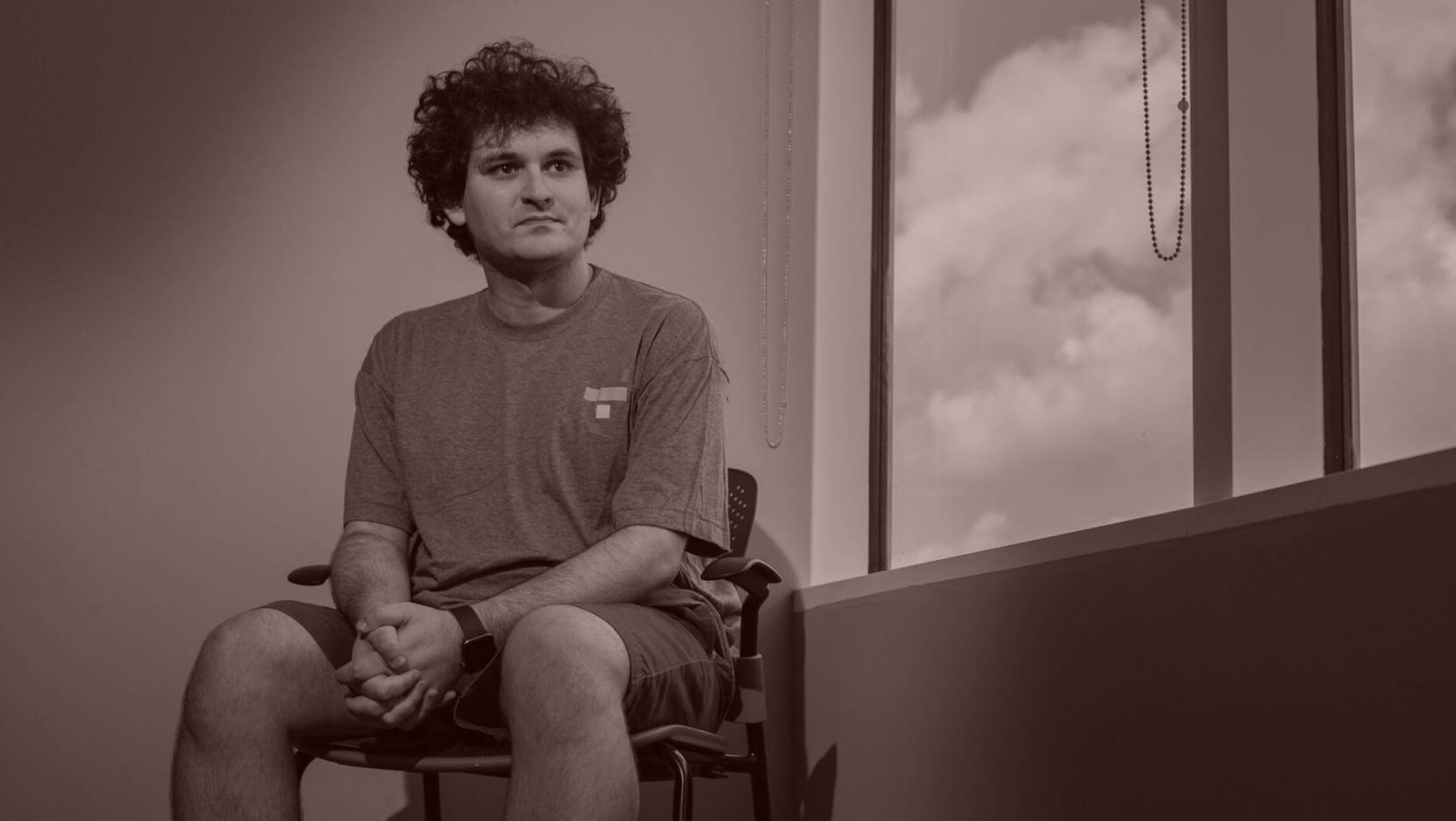
| The first thing that I noticed when Sam Bankman-Fried greeted me in the doorway of his family home, just off the Stanford campus, was the 75-pound German shepherd by his side named Sandor, a Hungarian spin on a name meaning “defender of men.” Sam seemed hazy on how exactly Sandor had gotten there—the dog had “just shown up” in his retelling, a gift over the last few days from his parents. But he was certainly a young man in need of both defense and a friend. After all, the second thing I noticed about Sam was, naturally, the G.P.S. monitor strapped tightly to his left ankle.
The fabric-and-battery contraption is a physical reminder, lest anyone forget, that S.B.F. is under house arrest as he awaits trial in October, facing eight counts of what prosecutors have called “one of the biggest financial frauds in American history.” After his first U.S. court hearing last month, he flew back to Northern California, where he has been living in a strange fugue state—between a billionaire and prisoner, a celebrated business celebrity and financial villain. Now his movements are circumscribed by law. He can step onto the thin porch outside the living room, but he isn’t sure he can walk much further—not that he has tested it, he assured me. He takes care to ensure his ankle monitor is fully charged, with its neon green light blinking every few seconds. “It’ll start barking at me if it gets low on battery,” he said.
Otherwise barefoot and wearing a plain red t-shirt and gray shorts, with his hair as disheveled as ever, S.B.F. and I shook hands as he welcomed me inside his parents’ ranch-style house. It was Friday night, and he seemed genuinely excited for the company. He and Sandor led me through the first floor of the home, past an activity room where Sam’s two chess sets and two gaming monitors sat center stage amid new Amazon packages, and then through the open kitchen, as we negotiated the best place for us to sit down and chat. His voice was startlingly unaffected; he offered me something to drink as if we were there for a playdate, as if nothing of consequence had recently transpired. Meanwhile, the house was totally silent. No one else appeared to be there: no lawyer or P.R. chaperone hiding around the corner, no aggrieved parents with a glass to the wall, listening in for some sort of confessional or obfuscation, perhaps to find out how their eldest son had brought them shame, blemished their careers, and unleashed the sort of havoc that will take years, if not decades, to unspool. It took me about 10 minutes to confirm with myself that this meeting was really happening.
Sam, himself, had ostensibly yet to fully grasp what in the world had happened: the weight of the allegations, the enormity, the consequences. Charlatans, even the alleged ones, come in all shapes and sizes. Bernie Madoff capitulated to the Feds immediately when they arrived at his Lexington Avenue penthouse because he was overwhelmed by the mental burden at the end of his Ponzi scheme. When John Carreyrou began circling Theranos, Elizabeth Holmes and her team of A-list litigators and flacks (and, later, her dog) punched back with legal threats and bias claims. S.B.F., on the other hand, seems little changed under house arrest from his comportment while he was scaling FTX, his cryptocurrency exchange: ever-strategic, somehow both deeply contemplative and negligently erratic, and operating on essentially another planet—a quality that once appealed to the investors at Sequoia and Tom Brady, but now simply seems at odds with the billions he cost customers and investors.
Sam has some gallows humor about the whiplash. Just over two months ago—before the collapse of FTX, before the paparazzi, before the $250 million bail that allowed S.B.F. to be released back to Palo Alto—Bankman-Fried sat uniquely atop global finance, living a glamorous life in the Bahamas and dispensing his political and philanthropic checks all over the world. He told me the other week, in our first interview since FTX’s meltdown, that he had distributed somewhere between $200 million and $300 million to various causes. Now, he sits stir-crazy all day, eating vegan burgers delivered to his home, playing video games, voraciously consuming Twitter, and doing a hell of a lot of ruminating and antsy pottering around his parents’ unostentatious $4 million home. It’s enough to make you recall the line from Dostoevsky: “If he has a conscience, he will suffer for his mistake. That will be his punishment—as well as the prison.” |
| “What I Can Do Is Limited” |
|
| I first talked with Sam back in the fall of 2020, a few weeks before Election Day, when I was wondering how this mostly unknown C.E.O., born just nine months before me, was donating $10 million to Democratic presidential super PACs. Sam and I came from somewhat similar backgrounds—both Jewish kids of professors—and we were both interested in the effective altruism movement. We’d talk or text every few months about politics or philanthropy, and I got to know some of his advisers and family well, too. I liked Sam, in retrospect, partly because of his accessibility. I never suspected that he was a fraud, but the speed and scale of his endeavors did always strike me as ripe for catastrophic errors.
When the FTX empire began to crumble, around the 2022 midterms, I waited a few days before texting him to see if he’d talk to me. Sam was then still in the Bahamas, spilling his guts to various media outlets. I arranged my own interview through his new public-relations maestro, Mark Botnick. But I’ll admit that I was somewhat surprised when, a few days after Christmas, S.B.F. himself responded to my request for an in-person visit, texting that he would be glad to have me over if I drove down from San Francisco. “Hey! I am allowed visitors,” he wrote me back. After some logistical back-and-forth, he said on Friday night that he was “free this evening FWIW” and about 90 minutes later, I was displaying my driver’s license under the flashlights of two security officers who led me into his home prison.
Over the course of two and half hours, Sam and I sat at the long wooden table in the Bankman-Frieds’ airy, late ‘90s-style kitchen: the stained wooden cabinetry with frosted glass, dark countertops, the subway tile backsplash with decorative notes of pastels. Cookware lay on the stove top, a few unwashed pots sat in the sink, two cords and a laptop were strewn about the table between us and across the kitchen island. Sandor rested a few yards behind me as Sam finished a vegan patty and wolfed down a packet of french fries that he had delivered just before I showed up. We drank sparkling water that he dispensed from a SodaStream as he doodled near-constantly on a Stanford University notepad.
During our time together—about one-third on the record, two-thirds off—Sam evinced his loneliness and his isolation, but also a hint of mysterious confidence, as if he could somehow wiggle his way out of his current predicament as he had in the past. He spoke carefully and repentantly when on the record, and loosely and almost gamely when off it.
There was an element of incredulity in his demeanor, as if he didn’t totally comprehend that his $32 billion company was bankrupt and that he might bleed his parents dry of cash and ruin the lives of the entire Bankman-Fried family. “It doesn’t feel like being bored during a vacation,” he said when I offered that description of his home confinement. “It feels simultaneously, very antsy and frustrating and stressful. And a lot of trying to find anything I can do, to the extent there is anything. But what I can do is limited.” He seemed occasionally unemotional about the last eight weeks, approaching the future as a hyper-rationalist might, more interested in learning about federal wire-fraud laws than about the people who lost money on FTX.
He seemed deeply frustrated with the public narrative turning against him, though he understood why it had happened, and I suppose was talking to me, at least partly, in an effort to reverse things. “You probably wish the trial was tomorrow,” I said, trying to ascertain his mental state. “Part of me certainly does,” he said, because he wanted to “try and return things a little bit more to the facts of the matter.”
Bankman-Fried believes the conventional wisdom in crisis management is too cautious and overly influenced by risk-averse lawyers. (I agreed with him, though I suppose I was also talking my book.) Sam has approached crisis comms in an unconventional way, to say the least, starting with his live interview with Andrew Ross Sorkin. After FTX collapsed, but before he was arrested, he slowly tweeted an acrostic that would eventually spell out “WHAT HAPPENED.” He has suffered through a recurring series of accidental interviews that he did not believe would be public, only to be embarrassed when he said explosively controversial things. And here he was with me.
One couldn’t help but feel that Bankman-Fried missed the ever-flowing adulation that he had manufactured in the past, the media narrative that had been cultivated around the mythology of the M.I.T. grad and hedge fund altruist turned DeFi wunderkind, the one that had transformed a last-pick-in-recess nerd into the guy who paid Larry David and Gisele Bündchen to appear in his commercials. For the better part of two years, everyone lusted after this guy, this persona—in his philanthropy, in his business life, and in his personal life—and he was able to spread his wealth to win attention and friends. People worked at FTX because they wanted to work with Sam, the boy genius. Nowadays, “it’s pretty much the opposite.” He said that he had not spoken at all to his former deputies Caroline Ellison, Nishad Singh or Gary Wang since things blew up in mid-November. I asked about his brother Gabe, but he was reticent to talk about his whereabouts, at least publicly.
I also asked if he had any childhood or high school friends who knew him before he got famous, and who might be swinging by to hang out and treat him more like a normal person rather than a scandalized celebrity. “A lot of the people who I was closest to were my colleagues,” he said, his voice halting. Obviously conversations with those people are now loaded and lawyered. “Most of the people who I was friends with are not talking to me,” he added. “I don’t blame people for wanting to try and avoid getting drawn into the shitshow as best they can.” |
|
|
| S.B.F. first broke a land-speed record for attaining fame, and then broke another for infamy. The velocity of his downfall has been plainly captivating. A little over a month ago, Sam was sitting in his Bahamas compound at around 6 p.m., revising a dramatic opening statement that he planned to deliver before a House congressional committee the next day, when suddenly he was surrounded by Bahamian police. As with Sandor’s arrival, he can’t be sure how the men with guns appeared at the complex where he was staying with his parents. He wasn’t by the door when they arrived.
Many in finance and media had been wondering whether an arrest was imminent. About a month earlier, FTX had declared bankruptcy following revelations that Sam had effectively lent some $10 billion of customer assets to Alameda Research, his investment firm. But Sam, who had publicly dismissed the possibility of an arrest just a few hours before he was taken into custody, said he was generally surprised when the police showed up. He had been eager to reveal more details to the public the next day about FTX’s collapse with his planned testimony, which was reportedly set to commence with the line, “I fucked up.”
Sam told me that line wasn’t actually expected to make it past his revision session that night, just as he was not expecting an out-of-nowhere arrest that evening. He thought he had more time. “I was not expecting the process to play out that quickly. You could have imagined a different process playing out there,” he said.
Instead, within minutes, he was frantically talking with his U.S. legal counsel. By then, of course, the arrival of men with guns had triggered an unstoppable series of events. Sam was loaded into a car and 30 minutes later he was at a police station, and then in a cell where he was held overnight before his hearing the next day. The following evening, he was moved to Nassau’s infamous Fox Hill correctional center, known for its rats and maggots. Sam was careful not to criticize the prison’s guards, but his stay there was clearly a haunting experience.
S.B.F. is a vegan, a trendy dietary restriction in Palo Alto, but not quite the sort of culinary preference that gets much deference in a gritty prison. That might seem like an obvious reality for some, but it seemed like it caught him off guard. Sometimes he would just skip a non-compliant meal and opt for a peanut-butter sandwich. “I spent a while trying to see how far a jar of peanut butter could get me,” he told me. “It was a little touch and go for a while,” he said of his health during those ten days. When I asked him what prison was like, he paused for thirty seconds before saying he wasn’t ready to publicly process his thoughts on the matter.
Despite the trauma, S.B.F. told me he did not regret agreeing to be extradited to the United States. He is digging in for the long haul and is visibly energized by working on his defense. He said he talks with his lawyers basically every day now, and he is trying to learn as much about the case as possible—each count, each possible witness, each prosecutor—to assess his own legal risk. Indeed, he now has copious free time, and he spends a lot of it regurgitating the past, writing pages upon pages of his recollections from the last few fateful days and weeks during which FTX crumbled, not necessarily for public consumption or for his lawyers but more for his own sanity and sense or order. “You find it helpful to write things out,” he said.
He also plays lots of video games—Storybrook Brawl, mostly—but not with other people, partially out of fear that someone on the platform would recognize his handle or voice. Plus, “it doesn’t really fully distract from what’s going on,” he said. He spends lots of time reading articles about his case and browsing the latest theories making the rounds on Twitter. “I end up reading a decent amount of what gets written, but it’s hard to do often,” he continued. “But I think it’s something I have to do.”
“Or not,” I offered. “Do you want to do meditation or something?” I asked, given his headspace. I wondered if he had contemplated therapy. “I’ve talked to therapists periodically for a decade,” he said. “There’s no escaping. The only way out is through.” Exercise similarly isn’t a priority, he said.
It’s not that I don’t believe Sam is contrite about what happened to FTX customers. It’s more that Sam is keenly aware that he is supposed to be contrite, and it can be hard to listen to his apologies and his pregnant pauses and his professed schemes to still help customers recover their money without feeling as though you are bearing witness to a form of performance art. He obviously knows he fucked up, and yet he has simultaneously seemed to orient himself as the victim in his catastrophe. He made a mistake and wants to atone, genuinely, but still very much on his own terms alone. |
|
|
| Sam seemed relieved to have regained access to the Internet, although it’s nothing like the frenzied human interaction at FTX. In the Bahamas, he was surrounded by lovers and colleagues and sycophants, always a call away from a celebrity or sovereign, with all the video games and bean bags to feed the myth. A $4 million house with Twitter access may be infinitely nicer than “Fox Hell,” but it’s clear that there are not many real people for him to talk to anymore, which is partly why I was there, I suppose. Ellison and Wang have flipped on him, pleading guilty and agreeing to cooperate with the Southern District of New York, and Singh is expected to do the same. “For a number of years, I was incredibly lucky and fortunate in terms of a lot of the relationships and support that I had,” he said. “Now there’s basically nothing left.”
I noted to him the irony that he can’t leave the house, and yet the house is all he has. His remaining relationships are basically only with his parents, who Sam said were upstairs, but whom I never saw or heard. Financially, all he has left is their property, which is being held as collateral if he flees before his trial. “Some people may have billions of dollars of customer assets to use for legal fees right now, but I’m not one of them,” he said in an ill-conceived attempt at a joke. What about his directors and officers insurance? “I don’t feel confident that anything is going to come through,” he said. “I’m gonna be out at some point maybe in the not-too-distant future.”
Part of the financial burn derives from his round-the-clock security. His parents are rightfully worried about their son’s safety. Sandor is here, courtesy of his parents. So are the two security guards that let me through the barricades and onto the street where the Bankman-Fried family lives, given that the street is now blocked off 24/7. Sam is realistic about the fact that “everyone” hates him, as he put it at one point. “People are claiming to want to come here to make a citizen’s arrest. I don’t get it. I’ve already been arrested,” he said. One citizen vigilante was stopped by guards, he recalled. His parents, he and I agreed, are lucky to not be public figures who will be recognized at the Trader Joe’s where they shop. For now, at least.
Sam’s emotional world, too, has narrowed to isolation and futility. He didn’t show overt signs of fear, or an indication that he believed that his life was falling apart, as some might expect. “In some sense there’s an unbelievable pile of things to do. Like, way too many things to do. But I don’t have the power to do a lot of them,” he said. “I don’t like feeling useless.” Partially out of boredom, he said he had reached out to the new C.E.O. of FTX, John Ray, six or seven times, to offer his help. As is to be obviously expected, Ray has kept his distance, but the stiff-arm has clearly frustrated S.B.F.
We talked about his case for a long time, too, but mostly off the record. Suffice to say he firmly believes that he is innocent. Nevertheless, toward the end of our evening together, I asked on-record if he was really going to fight this all the way. After all, it doesn’t take an M.I.T. physics genius to know that the legal deck seems pretty stacked against him. A plea bargain, if a reasonable deal is ever on the table, could result in a shorter sentence, even if his freedom may be decades away. Will he really be in the courtroom come October, fighting this with whatever money and dwindling sympathy he has left? “Yeah,” he assured me. “That’s the plan.”
Sam politely informed me that he had a call to join. I told him, before I left, that I wondered whether I would see him again. Perhaps I could stop by his house every few months as he prepares for his trial. He said sure, he’d still be there through October. I think I believed him, but I really had no idea. While the pressure to settle before trial will be enormous, Sam struck me that evening as someone who feels he has nothing to lose by incurring more risk. He is a public enemy, defended by a German shepherd, a few lawyers he will eventually struggle to afford, a pair of loving parents, and basically no one else. All he has left to bet on is himself, an instinct that worked in the past. Until, one day, it didn’t. |
|
|
|
| FOUR STORIES WE’RE TALKING ABOUT |
 |
| Zaz vs. Goliath |
| On the new M&A environment, Twitter, David Zaslav’s debt journey, the bulls, the bears, and more. |
| WILLIAM D. COHAN |
|
 |
| The Globes Woes |
| Is this the swan song for NBC’s Globes, or the start of a new chapter? |
| MATTHEW BELLONI |
|
 |
|
 |
|
|
|
|
|
 |
|
|
|
Need help? Review our FAQs page or contact us for assistance. For brand partnerships, email ads@puck.news.
|
|
|
|
Puck is published by Heat Media LLC. 227 W 17th St New York, NY 10011.
|
|
|
|