{{ 'now' | timezone: 'America/New_York' | date: '%b %d, %Y' }}
|
|
|
Welcome back to Dry Powder. I’m Bill Cohan.
We’ve got a great issue this
evening, largely focused on Goldman Sachs C.E.O. David Solomon’s extraordinary success at the bank. After dealing with some whining in the partner class a few years ago, he’s been on an extraordinary roll—vanquishing all dissent by closing the consumer division, merging the banking and markets group, and continuing to dominate the investment banking league tables. Now, Goldman is poised to take advantage of a fertile M&A environment.
But first…
|
- The
new corporate governance playbook: My former colleague Jonathan Foster has joined the small coterie of Lazard bankers who have also become authors: yours truly; the late and legendary Felix Rohatyn, who wrote three books, including a memoir, Dealings; David Supino, my former boss and a true Renaissance man, who has written extraordinary bibliographical catalogs of Henry
James and Joseph Conrad; and the late, great Vernon Jordan, who wrote two books while he was at Lazard. (I’m sure I’m missing someone, so please let me know.)Foster’s forthcoming magnum opus, On Board: The Modern Playbook for Corporate Governance, offers both a history of the role of directors on corporate boards and a practical discussion of how individuals can excel in those roles. Foster
should know. He’s been on 50 or so corporate boards at this point, including about 15 public company boards. I told him recently he’s right up there with Sidney Weinberg, the longtime senior partner at Goldman Sachs, who was once on 35 corporate boards at pretty much the same time.
Foster begins On Board with a few illustrative stories: There was one board meeting where a director fell asleep, and another in which a United Airlines board member
appeared particularly concerned about whether free first-class tickets would remain as a perk. You get the gist. During his journeys, he figured that directors could—and should—do better. “I hadn’t found a book that explained the contemporary history of transactions, E.S.G., and institutional investors, which have led to today’s laws, regulations, and expectations for good governance,” he told me the other day. “Only with that context can you talk about the key issues. So that’s what I
set out to write.”
For the book, Jonathan conducted 77 interviews over four years with sources as varied as Admiral Mike Mullen and restaurateur Mario Carbone, “who talks leadership as well as any C.E.O.” Topics discussed in the book include why directors aren’t more rigorously evaluated for the job, and why it’s so difficult to purge directors who stink. He also writes about the “information asymmetry” between C.E.O.s
and directors—a very real challenge inherent in governance. C.E.O.s spend 3,000 hours a year, or more, on their companies; directors maybe 200 hours a year. How can the latter ever know enough about the company they are supposedly responsible for?
In fact, he posed that very question to Peter McCausland, the billionaire founder of Airgas Inc. (and our neighbor in Nantucket). “He made a simple and great comment,” Foster said, “and he’s dead right,
and I’ve done this [myself]. He said: ‘You have to be unafraid to say, “I’m not making that decision until I have more information, period.”’” Good advice, indeed. And more directors would be well advised to follow it.
On Board goes on sale Tuesday.
|
|
|
A MESSAGE FROM OUR SPONSOR
|
DESIRE MORE
Peerless
refinement. Uncompromising capability. Range Rover is the natural choice for those who lead by example.
EXPLORE
|
|
|
- A
quick update on the Saks Global debt hunger games: On Thursday, Saks Global reported some sparse information about its first-quarter results. The net loss for the quarter was $232 million, compared with $184 million in 1Q24. Any comparisons with last year are difficult, of course, since the Neiman Marcus Group combination closed last December. (If earnings were pro-forma for the NMG combination, however, the net loss was $168 million, because Neiman made money and Saks didn’t.) The company
made $13 million in adjusted EBITDA during the first quarter, but good luck deciphering the relevant adjustments, which apparently do not include a $13 million EBITDA loss attributed to the separate Saks ecommerce platform. A year earlier, without Neiman, Saks reported an adjusted EBITDA loss of $1 million. Meanwhile, revenue for the first quarter was $1.6 billion, compared to $900 million a year ago without Neiman and $1.9 billion with Neiman.As for liquidity
at the end of the quarter—the detail that every creditor and vendor wants to know—Saks Global reported having $326 million of cash and availability under its ABL line, and around $850 million of liquidity as of June 27, following the deal with the holders of 54 percent of the 11 percent, $2.2 billion bonds issued in December. That $850 million balance has since been reduced by around $120 million, after Saks made its first interest payment on those bonds at the end of June.
Marc
Metrick, the Saks Global C.E.O., has been crowing about the results, although I’m not sure why, exactly. Maybe he has no choice, which I get, although this strikes me as borderline delusional. “We are pleased to report that we continue to make solid progress in executing our transformation, and our first-quarter results came in slightly better than expected,” he wrote to vendors after the call with bondholders, “as we had planned for continued inventory pressures, short-term effects of
our integration work and more cautious spending by luxury consumers. We know there is more to do, and as we move through the second quarter and into the back half of fiscal 2025, we are grateful to be working closely with you as we enhance our assortments.”
Metrick also introduced Saks Global’s new C.F.O., Brandy Richardson, who starts August 18. (Welcome to the fire, Brandy.) First up on her plate, I’m sure, will be mollifying Saks’ increasingly peeved
vendors. As faithful readers know, on Valentine’s Day, Metrick told vendors that Saks Global would be stretching payables from 30 days to 90 days—one of the first signs of financial trouble at any company. But I’ve heard from some vendors who shipped new inventory on March 1, after Valentine’s Day, and who expected to get paid on July 1, and guess what? They still haven’t been paid in full. In fact, I’m told that some vendors were paid a very small percentage of what they were owed, and
that messages sent to Metrick have not been returned. Referring to Metrick’s Thursday email, one vendor wrote, “They use the word ‘partner’ often, but a more accurate word should be ‘sucker.’ They have clearly lied to their vendors in a way that Trump would be proud of. We have now reached our end with them and will be moving on (despite them wanting to order several million dollars of future merch) after we collect what’s owed… which we will do one way or another.”
A spokesperson for
Saks Global declined to comment, but a person close to the company told me he’s not surprised that some vendors have still not been paid after 90 days. “We’ve probably missed some payments or are behind with some folks,” he said. “I don’t doubt that it happened. When I look at our past-due accounts payable, the vast, vast majority of our accounts payable is on time. But… I’d be shocked if we weren’t behind with a few folks.”
This is obviously rather troublesome. If you set up a new
payment plan for vendors and you violate it right out of the gate, while also boasting about how much “liquidity” you have, something isn’t adding up.
Anyway, the first-quarter results also appear to have landed with a bit of a thud for Saks bondholders. For the unlucky 46 percent of bondholders, who the 54 percent screwed over, their bonds have traded down to 31 cents on the dollar, from 35 cents, in recent days. As for the bonds of the 54 percent? They are trading at around 50 cents on
the dollar, down from 60 cents after the new financing was announced, although I’m told no one is really bidding. Will this thing make it to Christmas?
|
|
|
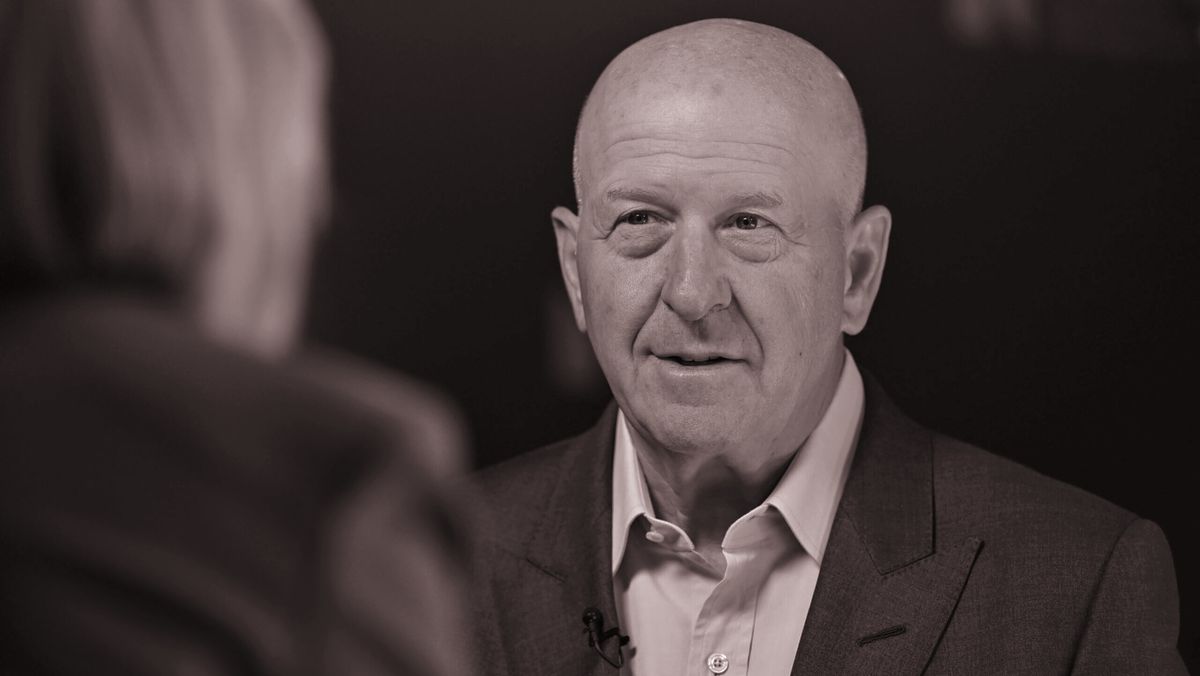
David Solomon has Goldman Sachs operating as effectively as ever—returning billions to
shareholders and prepared to take advantage of the regulatory environment to capitalize on a fertile M&A landscape.
|
|
|
Somehow, despite the chaos in Washington embodied in Trump’s “Liberation Day”
mishegas, the big Wall Street investment banks had a terrific second quarter. JPMorgan Chase, Jamie Dimon’s money-printing machine, generated $15 billion of net income in the quarter, putting it on track to potentially hit $60 billion of net income for the year—a feat that no American bank has ever achieved.
Their investment banking business generated fees of $2.5 billion, which is up 7 percent year over year, driven largely by increases in M&A advisory
and debt underwriting fees, and offset by a decline in equity underwriting fees. Clearly, the JPMorgan Chase bankers do not abide by the “three-six-three” rule: Borrow at 3 percent, lend at 6 percent, and be out on the golf course by 3 p.m.
If Jamie had also managed to solve his succession dilemma—at 69 years old, he perpetually seems to be sticking around for another five years—he’d have the Mount Rushmore of Banking, if there was one, all to himself. Instead, he’s got to make room for
David Solomon at Goldman Sachs. Unlike Jamie, David has lined up a successor. He’s been Goldman’s C.E.O. since 2018, and when his time comes to move on, he’ll almost certainly hand the title over to John Waldron, his longtime sidekick who flirted with moving to Apollo Global before being lured back into the fold with an attractive stay bonus of $80 million in restricted stock. Waldron was also elevated to the Goldman
board.
After a rough patch, caused largely by the flailing consumer banking division and some itchy partners, Solomon has Goldman looking as Goldmanesque as ever. David was smart enough to pull the plug on the consumer banking effort, but also clever enough to give it a try before concluding that it wasn’t working. As with JPMorgan Chase, everything seemed to be working at Goldman in the second quarter. It was the kind of economic environment in which Goldman excels: The chaos
and volatility, as Solomon said on the earnings call, led to “policy uncertainty [that] drove clients to reposition portfolios and recalibrate risks across asset classes.”
|
|
|
A MESSAGE FROM OUR SPONSOR
|
DESIRE MORE
Peerless
refinement. Uncompromising capability. Range Rover is the natural choice for those who lead by example.
EXPLORE
|
|
|
In other words, Trump’s daily insanity plays to Goldman’s strengths as a firm. Goldman’s second-quarter net
revenues of $14.5 billion were up 15 percent year over year, from $12.7 billion, and its six-month net revenues are up 10 percent from the same period last year. Net earnings of $3.5 billion for the second quarter were up 22 percent from a year earlier. “These results are a testament to our best-in-class talent, culture of collaboration, and differentiated business across investment banking, financing, risk intermediation, and asset and wealth management,” Solomon said. “Our global client
franchise has never been stronger.”
|
Like JPMC’s, Goldman’s investment banking business has excelled. While debt and equity underwriting fees were
essentially flat year over year, the M&A business seemed to really pick up steam in the quarter—with fees increasing 16 percent, to nearly $2 billion, from $1.7 billion a year earlier. David explained that M&A volumes so far in 2025 are 30 percent higher than a year ago—and 15 percent above the comparable five-year average—while the firm’s “backlog” was up for the fifth consecutive quarter. “Clients continue to turn to our number one M&A franchise for their most consequential transactions,” he
said. (He’s not wrong.)
Mike Mayo, the respected Wells Fargo research analyst and friend of the house, pressed Solomon on whether the long-anticipated boom in M&A activity was finally here. Yes, David said. “The level of dialogue is significantly increased,” he replied, which is banker-speak for C.E.O.s are thinking seriously about doing deals again. “New business opportunities are up,” he added, “and it feels like we’re entering a period of a higher
level of activity.”
Mayo also asked Solomon if Goldman itself was looking at doing big corporate deals, something it has historically been terrible at for reasons that have always been a bit of a mystery (and, in any event, that its prudential regulator at the Federal Reserve have ruled off-limits since the 2008 financial crisis). But given the more liberal regulatory environment that seems to be emerging, Mayo’s question was a good one. Solomon, of course, was too smart and
seasoned to answer it directly. He replied that Goldman is looking to keep growing its asset and wealth management business—it’s now a $3.3 trillion “platform,” he said—and that would be the potential focus of the firm’s M&A activity in the near term. “But I don’t have anything to add more specifically at this point, Mike,” he concluded.
Solomon also shared that Goldman now does more business with 125 of the top 150 clients globally. (He didn’t specify what measure he was using to define
“top,” but my guess is total enterprise value—which would be typical banker thinking.) That’s an impressive increase in “wallet share,” as they say on Wall Street. He attributed the improvement to the decision to merge the firm’s banking and markets groups. “It’s been very effective,” he said. “It’s a different operating ethos. There have been significant behavior changes over the last five-plus years in the firm in terms of the way people think about clients, think about servicing clients,
think about meeting their needs, and think about getting resources that clients need in front of them.”
The final notable announcement from the quarterly call was that Goldman would be increasing its quarterly dividend to $4 a share—a 33 percent increase, underscoring, David said, “our confidence in the durability of our franchise,” but also due to the fact that the Fed loosened capital rules in June, allowing big banks to return more capital to shareholders. Goldman’s annual dividend, which has increased 400 percent since 2018, is now $12 per share. Goldman’s annual dividend is now $12 per share. Given that Goldman now has 320.8 million shares outstanding, the firm will be paying out $3.8 billion a year in cash to its shareholders. Go get yourself some of that pot. (This is not investment advice, of course.)
Since Solomon owns around 150,000 Goldman shares, worth $106 million these days, he’ll be taking in another $1.8 million in cash dividends a year now, on top of his $39 million 2024 compensation package and his own
$80 million stock retention bonus. There’s a reason these guys at the top like to stick around forever.
|
|
|
Ace media reporter Dylan Byers brings readers into the C-suite as he chronicles the biggest stories in the industry: the future
of cable news in the streaming era, the transformation of legacy publishers, the tech giants remaking the market, and all the egos involved.
|
|
|
Join Emmy Award-winning journalist Peter Hamby, along with the team of expert journalists at Puck, as they let you in on the
conversations insiders are having across the four corners of power in America: Wall Street, Washington, Silicon Valley, and Hollywood. Presented in partnership with Audacy, new episodes publish daily, Monday through Friday.
|
|
|
Need help? Review our FAQ page or contact us for assistance. For brand partnerships, email ads@puck.news.
You received this email because you signed up to receive emails from Puck, or as part of your Puck account associated with {{customer.email}}. To stop receiving this newsletter and/or manage all your email preferences, click here.
|
Puck is published by Heat Media LLC. 107 Greenwich St, New York, NY 10006
|
|
|
|