Welcome back to Wall Power’s Inner Circle. I’m Marion
Maneker.
Tonight, I’ve got data from the London and Paris auctions compiled by our friends at ARTDAI. The numbers show that the art market is healing—lending substance to an anecdotal detail from the front lines of the recent fairs, as I noted yesterday, that hasn’t entirely entered the media narrative until now.
There seems to be a new mood in the market: Estimates have come down and buyers are competing again. It’s still way too early to declare legit forward
momentum, but London and Paris have sent positive signals, and this month’s sales in New York will have an even greater impact on market psychology. More on this below.
But first… |
- Notes on the Philadelphia museum scandal: I’ve been perplexed by the unfolding saga of Sasha Suda, the director of the Philadelphia Art Museum, who was just fired on the day before the debut of one of the museum’s biggest international shows. Yesterday, Philadelphia reported that Suda had received an email at 9:03 a.m.
informing her that the board was terminating her for cause over an institutional rebrand, about which trustees apparently felt they had not been sufficiently consulted. Anyway, tonight is the opening reception for Dreamworld: Surrealism at 100, a major touring retrospective that has been in Paris, Madrid, Brussels, and Hamburg. Hosting the exhibition ought to have been a defining moment for the museum, but for now, the mini-scandal will hang over it.
I checked with some folks
close to board members, who suggested that the board is “very large and powerful” and that Suda had not been able to assert control over it in her three years at the helm. There was also friction over Suda not granting the board access to the staff. In this version of events, the rebranding just became the last straw. But the board’s actions have created a possibly worse situation. In the best-case scenario, the surrealism show will be a big success and Suda’s defenestration quickly forgotten.
In the worst case, it will now be even harder to find a great director—who wants to deal with that board? Now the trustees need to find a leader who can tame the board, raise money, and keep bringing world-class shows to a world-class museum in a city that is rapidly becoming an art hub, especially with the recent opening of the Calder Gardens.
|
|
|
A MESSAGE FROM OUR SPONSOR |
The first steps towards a masterpiece starts with a dream. The all-electric BMW i7 – the
evolution of brilliance. Learn more at BMWUSA.com |
|
|
- Freeman’s ditches Hindman: Chicago regional auction powerhouse Hindman acquired Cincinnati’s Cowan’s Auctions in 2019. Then, in 2023, the firm added Philadelphia’s Freeman’s, all under the majority ownership of Chicago billionaire Jay Krehbiel. Now, in celebration of Freeman’s 220th anniversary, the company is rebranding under the Freeman’s name.
It makes sense. No one really knew how to refer to “Freeman’s | Hindman,” especially with that pesky bar in the
title. The firm is also planting its flag firmly in the middle market. According to C.E.O. Alyssa Quinlan, the company saw a 9 percent increase in sales year over year. Going forward, the company will continue to focus on collections in the $1 million to $5 million range. - Yoshitomo Nara drops a bomb: By now you’ve heard the news that Yoshitomo Nara has left Pace for David Zwirner. This comes soonish after his longtime
dealer, Timothy Blum, announced he would be closing his gallery. So it was not a total surprise that Joe Baptista, a former partner at Pace, emerged as an agent representing Nara with Zwirner. Mid-to-late-career artists have a tendency to switch dealers, and the 65-year-old Nara seems to be doing the same as he transitions his own practice away from painting and toward sculpture.
There’s a certain logic to Nara winding up at
Zwirner. He spent formative time in Germany and speaks German. Zwirner has also handled Yayoi Kusama quite well, though it’s not clear that Nara wants Kusama-like global domination: He’s reputed to run a very small studio, produce only a few paintings a year (plus lots of drawings, for which there seems to be deep demand), and not have much in the way of material needs. But like a lot of artists, he has frustrations with the art market. What Nara, Baptista, and Zwirner do next
will be interesting to watch.
|
Now, let’s get to the main event… |
|
|
The numbers from October’s European auctions are in, and they are
defying the tired narrative of a moribund art market. In fact, according to the data, the market is strong and getting stronger. |
|
|
It’s too soon to declare with any numerical certainty that the art market has
regained its mojo, but the results from October’s auctions in London and Paris are surprisingly strong given the pessimism we’ve become accustomed to. In fact, the numbers we do have from those recent sales, via ARTDAI, reveal an
unusually high general level of interest in buying art. According to Pi-eX, almost £383 million was spent—just under the peak of nearly £400 million that the combined London and Paris sales reached in 2017. Given the prevailing narrative for the European market—and the art market as a whole, for that matter—this result gave me no small amount of surprise and some satisfaction.
The overall hammer ratio for these sales also offered welcome news at a solid but not exciting 1.07—meaning the aggregate
hammer price of all the sold lots exceeded the aggregate estimate of all the offered lots by 7 percent. After the low hammer ratios and declining estimates of the past three years, that figure reveals a slightly positive market in which bidders are showing interest above and beyond the estimate level. Still, the results are hardly uniform. Of the 14 sales in London and Paris, more than a third had hammer ratios below 1.00 and only four had hammer ratios above 1.20, or what can be reasonably
viewed as bullish. |
|
|
A MESSAGE FROM OUR SPONSOR |
The first steps towards a masterpiece starts with a dream. The all-electric BMW i7 – the
evolution of brilliance. Learn more at BMWUSA.com |
|
|
All these results come from ARTDAI’s tracking of 1,015 lots offered in both European
capitals. A total of 872 of those lots found buyers—among them, 33 percent were the subject of very competitive bidding; 43 percent were sold within the estimate range; and 23 percent were sold at compromise prices below the estimate level. Measured in dollars, $183 million, or 37 percent of the total $497 million in sale value, was the subject of aggressive bidding; $224 million in art, or 45 percent of the total sale value, was sold within the estimates; and only 18 percent of the sale value,
or $89 million, went for prices below the estimate. There were 112 sold lots with guarantees of some kind for a total of $185 million, meaning roughly 37 percent of the value was guaranteed. The auction houses seemed to have absorbed an additional $4.7 million worth of guaranteed art that did not find a buyer on the auction block. |
The top 10 lots by price were a mix of the most-valued names in the art market. Some
attracted bidders while others sold as expected or for slightly higher compromise prices—a reminder that we’re still a ways away from a bull market.
An Amedeo Modigliani portrait led these lots, selling for more than $31 million with fees, against an estimate around $6 million. Yves Klein’s massive IKB painting California, from 1961, was the second highest at more than $21 million, which was right around the estimate level. The next two roughly
doubled their estimates: Peter Doig’s Ski Jacket, from 1994, sold for $19 million, and Francis Bacon’s Portrait of a Dwarf, from 1975, sold for almost $18 million.
The remainder sold above their estimates, with one exception: Lucian Freud’s unfinished self-portrait fragment, from 1956, sold for $10 million, just below the estimate. Doig’s Country Rock, from 1998; René Magritte’s La magie
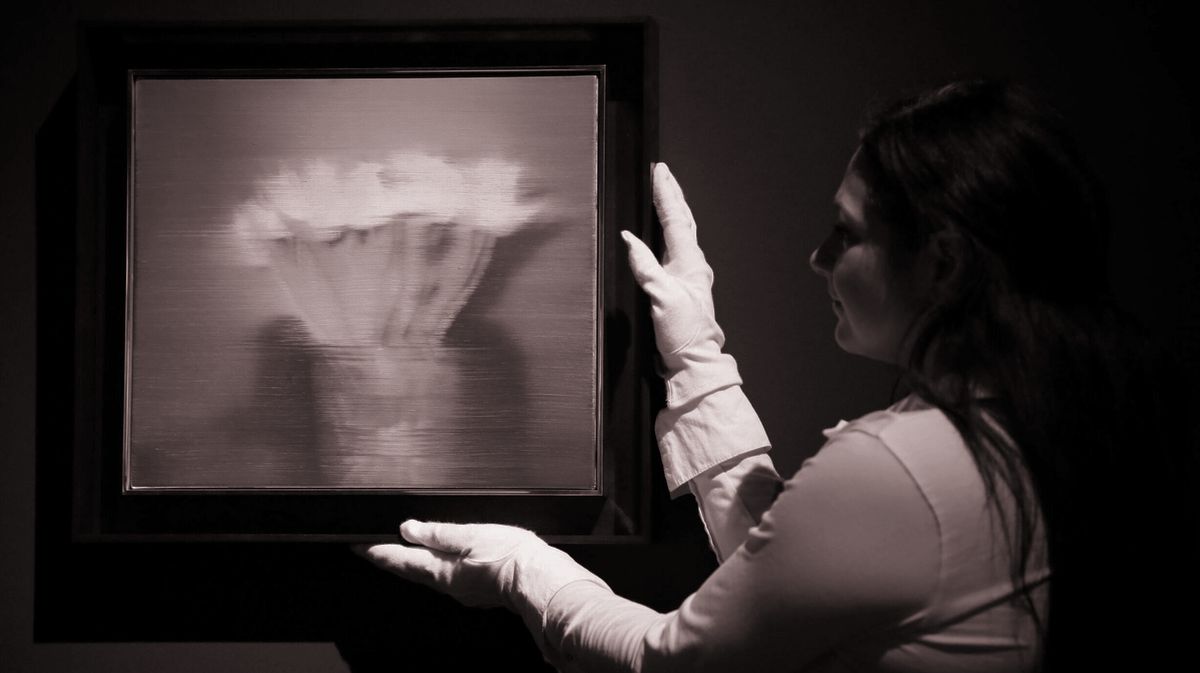
noire, from 1934; and another Modigliani, Raymond, from 1915, all sold above their estimates to make more than $12 million. Gerhard Richter’s blurry tulips from 1995 exceeded its estimate by 60 percent, selling for a little more than $8 million. Finally, a small Bacon study for a self-portrait from 1980 sold for almost $8 million, slightly above the estimate level. |
The top 10 lots by hammer ratio were mostly cases in which bidders latched on to
low-value works of very big names that they thought were of exceptional interest or value. Magritte’s untitled 1919 nude was offered in London for $2,700 but sold for more than $68,000. A Joan Miró untitled work was offered for less than a thousand dollars and sold for close to $10,000. A 2011 Michelangelo Pistoletto was offered for $34,000 but sold for $320,000. An Édouard Manet portrait of Ambroise Adam set in a garden was
offered at $115,000 but sold for $1 million. Works by Miriam Cahn and Nicholas Kalmakoff performed similarly, with estimates just above $10,000 and sales around the $80,000 level. David Hockney’s Arrival of Spring in Woldgate, East Yorkshire, from 2011, sold for nearly five times the estimate to make just above $1 million. Another Hockney performed almost as well. In fact, many of the works in the dedicated Hockney sale at
Sotheby’s saw a similar bidding profile, and that entire sale had an astonishing hammer ratio of 2.80. Finally, there were works by Jean-Gabriel Domergue and one attributed to Léon Bakst that sold for approximately five times their low-five-figure estimates. |
|
|
These numbers suggest that buyers continue to be very picky about what they compete
for. Rather than considering the market to be undervalued, they are searching for hidden value. |
Finally, of the more than 475 artists represented in these sales, the top 10 reflect
the breadth of the art market and the potential for any of them to attract more buyers. Modigliani was the star of Paris with $43.5 million in sales at the auctions (and an additional $10 million paid at Pace’s booth in the Grand Palais), amounting to nearly 9 percent of the money spent in London and Paris. Peter Doig was a close second with nearly $32.8 million in auction sales, or 6.6 percent of the total. Francis Bacon has just short of $26 million in sales, or a little more than 5 percent.
Yves Klein totaled more than $23 million, or 4.7 percent. René Magritte sold just under $20 million in London and Paris, for just under 4 percent of sales. Lucian Freud’s total was nearly $18 million, Paul Signac had nearly $16.5 million, and Pablo Picasso brought in under $15 million. The figure for Jean-Michel Basquiat was a little more than $12 million, and Marc Chagall continued his emergence as a market force with more than
$10 million in sales, or just above 2 percent of the spending in these auctions.
After lackluster midseason sales in New York and less-than-thrilling Hong Kong auctions, solid European sales are a sign that the art market is continuing to heal. Confidence is building among both buyers and sellers. This is at the core of the disconnect between the press and the market
that I discussed yesterday: Market participants are feeling the growing good vibes, even if they haven’t broken through the surface yet. |
I think that’s enough for today. We will be back on Friday for the official kickoff of
the November sales.
Look for us then,
M |
|
|
The ultimate fashion industry bible, offering incisive reportage on all aspects of the business and its biggest
players. Anchored by preeminent fashion journalist Lauren Sherman, Line Sheet also features veteran reporter Rachel Strugatz, who delivers unparalleled intel on what’s happening in the beauty industry, and Sarah Shapiro, a longtime retail strategist who writes about e-commerce, brick-and-mortar, D.T.C., and more. |
|
|
Finally, a media podcast about what’s actually happening in the media—not the oversanitized,
legal-and-standards-approved version you read online. Join Dylan Byers, Puck’s veteran media reporter, and Julia Alexander, a longtime media analyst, as they sit down with TV personalities, moguls, pundits, and industry executives for raw, honest, sometimes salacious conversations about the business of media and its biggest egos. New episodes publish every Tuesday and Friday. |
|
|
Need help? Review our
FAQ page or contact us for assistance. For brand partnerships, email ads@puck.news.
You received this email because you signed up to receive emails from Puck, or as part of your Puck account associated with {{customer.email}}. To stop receiving this newsletter and/or manage all your email preferences, click here. |
Puck is published by Heat Media LLC. 107 Greenwich St., New York, NY 10006 |
|
|
|