|
Welcome back to Dry Powder. I’m William D. Cohan.
What a day in the markets. The morning was consumed with horrors about the alleged machinations of our foreign creditors before Trump announced his 90-day tariff moratorium (kind of, mostly) around midday. But the real action has been, and continues to be, in the bond market. And that’s the subject of today’s issue, which I’m sending out a bit early on this bizarre and semi-historic day.
But first…
|
- Trump whiplashes the Ackman crowd: I know many of you are sick of Bill Ackman, and wonder why I keep writing about him. I guess it’s because we have a symbiotic relationship that goes back decades now. He’s also an important investor, despite his regular histrionics, and he does a lot of inane things, many of them in public. More appositely, for our current purposes, he’s the most vocal representative of a billionaire investor class that gave Donald Trump a resounding endorsement on the economy (and pretty much everything else, too)… and is now pleading with the president to cede to reason.
Ackman’s latest shenanigans involved a weekend rant against Trump’s tariffs, and specifically against Howard Lutnick, the Commerce secretary whose slavish devotion to the president and his global trade war has frustrated even senior White House officials, according to the Journal. “I just figured out why @howardlutnick is indifferent to the stock market and the economy crashing,” Bill posted on X on April 6, after 10 p.m. “He and Cantor”—Lutnick’s Wall Street firm—“are long bonds. He profits when our economy implodes. It’s a bad idea to pick a Secretary of Commerce whose firm is levered long fixed income. It’s an irreconcilable conflict of interest.” Wowza. Bada bing. The post got more than 10 million views.
But—as is usually the case with Ackman—there’s more. Earlier in the day, he’d urged Trump to take a 90-day timeout on the imposition of worldwide tariffs to see what could be negotiated on a bilateral basis, as opposed to just going nuts on everyone all at once. “By placing massive and disproportionate tariffs on our friends and our enemies alike and thereby launching a global economic war against the whole world at once, we are in the process of destroying confidence in our country as a trading partner, as a place to do business, and as a market to invest capital,” he wrote. “The president has an opportunity to call a 90-day time out, negotiate and resolve unfair asymmetric tariff deals, and induce trillions of dollars of new investment in our country.” Without a pause, Ackman intoned, we would be heading into an “economic nuclear winter.” (He seems to have gotten his wish.)
He also offered a mea culpa of sorts: “I don’t think this was foreseeable,” he wrote. “I assumed economic rationality would be paramount.” Really, Bill? Not foreseeable?
I’m not sure if Bill got a call from the White House to clam up. (He declined my requests to chat.) But next thing you know, he was reversing course. On Monday, he posted that it was “unfair of me” to “lash out” at Lutnick. “I don’t think he’s pursuing his self interest. … I am just frustrated watching what I believe to be a major policy error occur after our country and the president have been making huge economic progress that is now at risk due to the tariffs.” (Not sure there’s any evidence of “huge economic progress,” Bill, but whatever.)
He then pinned a tweet to the top of his X account: “Some have misinterpreted my thoughts on tariffs. I am totally supportive of President [Trump] using tariffs to eliminate tariffs and unfair trading partners, and to induce more investment and manufacturing in our country.”
The various reversals brought out the Twitter peanut gallery, with economist Nouriel Roubini leading the charge. “Only 4 months ago you were brownnosing [Lutnick] like a sycophant for ‘driving our economy,’” Roubini wrote. “Now you accuse him of driving the economy off the cliff because of financial self-interest, i.e. profiting from low bond yields!” That prompted Dan Loeb, an occasional hedge fund rival of Ackman’s, to tweet three popcorn emojis.
Anyway, around lunchtime, Bill’s prayers were answered, and Trump capitulated to the 90-day pause. “This was brilliantly executed by @realDonaldTrump,” Ackman posted in response. “Textbook, Art of the Deal.” He chose the above as his new pinned tweet, for good measure.
|
|
|
|
Trump’s global tariff war has wiped out more than $5 trillion in equity-market value. But, as always, the most reliable clue about what’s heading our way is the bond market. Buckle up…
|
|
|
|
The meltdown in the equity markets continues to get the lion’s share of headlines: four days straight of around 3 percent declines, the worst since October 1987, followed by a buying frenzy on Wednesday after Donald Trump said he was enacting a 90-day pause on his “reciprocal” tariffs, except for China. But forget the equity markets for the moment. The more telling signal of the coming financial calamity can be found in the bond market.
Few people understand the machinations of the bond market, with its arcane argot and tendency toward inscrutability. But it’s the bond market that better telegraphs what the cost of capital will be, and how collective risk tolerances are changing, and how quickly. After all, when people start freaking out about whether they’ll get their money back, as contractually agreed by the government or by corporations, while also worrying about receiving contractually agreed interest payments, the shit really starts hitting the fan. That’s where we are now.
|
|
|
|
A MESSAGE FROM OUR SPONSOR
|
DESIRE MORE
Peerless refinement. Uncompromising capability. Range Rover is the natural choice for those who lead by example.
EXPLORE
|
|
|
|
Initially, after Trump’s Rose Garden tariffpalooza announcement, there was a rally in the bond market. In advance of “Liberation Day,” the yield on the 10-year Treasury fell from 4.22 percent to as low as 3.86 percent. To me, and my Wall Street sources, this swift and sizable drop in yields appeared to be nothing more than the proverbial flight to safety, a knee-jerk reaction to the mayhem in the equity markets. This is the standard investor response to exogenous shocks: Sell risky assets first, then head for the safety—or the perceived safety—of the U.S. Treasury market, and ask questions later.
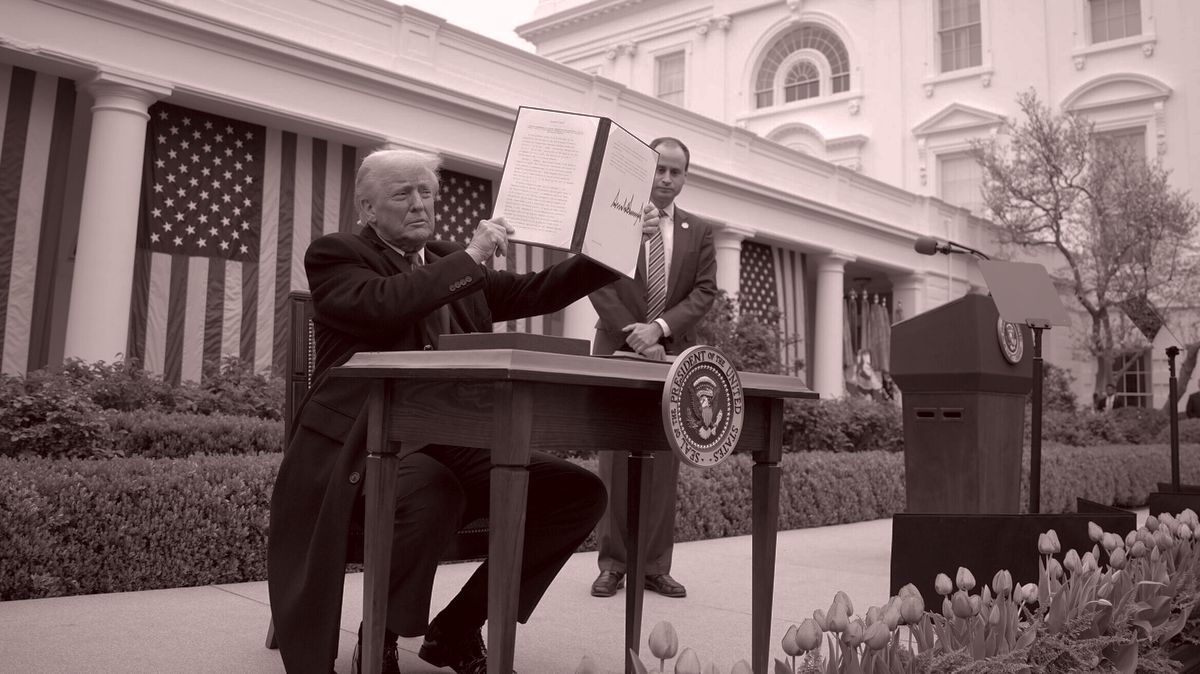
With the bond market seemingly moving the administration’s way, Trump’s sycophants—including Scott Bessent, the Treasury secretary, and Howard Lutnick, the compliant Commerce secretary—took victory laps over the weekend as part of their unarticulated agenda to bring down long-term interest rates. (Jay Powell, the Fed chairman, has so far resisted Trump’s entreaties to lower rates at the Fed level.) One of the theories making the rounds on Wall Street, of course, has been that the White House was intentionally nuking the stock market in order to secure lower interest rates on the refinancing of $6.5 trillion in U.S. government debt that comes due in June. According to Bessent, a 1 percentage point reduction on the interest rate of the Treasury debt saves the federal government $100 billion in interest payments annually. Worth fighting for, I guess, but at the expense of wiping out trillions in equity-market value and sending the economy into recession? I’m not convinced.
In any event, that plan—such as it was—now appears moot. On Monday, the 10-year Treasury yield backed up from 3.89 percent to around 4.12—a 6 percent move in one day, and a clear signal that bond investors are getting very nervous about whatever the heck is going on at the White House. On Tuesday, it backed up even more, to 4.25 percent—a 9 percent increase over two days. By Wednesday, the 10-year Treasury was yielding 4.54 percent. (After Trump announced the 90-day pause, the yield moved down slightly, to 4.4 percent; I’m sure he was hoping for more.) “What do bonds know?” tweeted Lawrence McDonald, author of the new book How to Listen When Markets Speak and the classic A Colossal Failure of Common Sense, about the collapse of Lehman Brothers, where he was a vice president on the credit desk. “Last 20 years, large equity market risk-off events have—always—brought in ‘flight to quality’ buyers of long duration U.S. Treasuries. Not this time.”
On the phone from Panama, where he lives part-time these days, McDonald told me he’s hearing a few signals from bond market investors. One is that there’s chatter that the Chinese will further retaliate against Trump’s tariffs by reducing the amount of U.S. Treasuries they buy in the upcoming auctions—which would, in part, account for the increase in yields on the 10-year. In other words, to induce our largest creditors, many of whom are foreigners, to buy our Treasuries, they are going to have to be rewarded with higher yields. China owns some $760 billion of U.S. Treasuries, and is one of our largest foreign creditors, so there are other ways the Chinese can rattle our economic cages, and they can do it quietly and without explanation. McDonald said he’s hearing murmurs from the Chinese along the lines of, “You pissed us off, maybe we’re not going to buy your Treasuries.”
Our friend Anthony Scaramucci, the hedge fund manager who called Trump “boss” for 11 days in 2017, agreed with McDonald’s take about what seems to be happening in the Treasury market. “Feels like the market is pricing in foreigners boycotting U.S. bonds,” he tweeted on Tuesday morning. “Market pricing lost confidence in U.S. due to Administration incompetence.” Whatever the case, the first serious test regarding the appetite for U.S. bonds will come today, when the Treasury needs to refinance $39 billion worth of 10-year Treasuries.
|
|
Then there is the message coming from the high-yield market. I love the high-yield market for what it tells investors about the zeitgeist of risk. The junk-bond market—created in the 1980s by the Trump-pardoned Mike Milken at the long-defunct Drexel Burnham Lambert to provide financing to companies with less-than-stellar credit ratings—is one of the places risk goes to hide. When people are feeling risk-averse, the yields in the junk-bond market shoot up wildly. For instance, in March 2020, as the reality of Covid began setting in with investors, the high-yield bond index spiked dramatically, to an average yield of 11.4 percent. Then, of course, the Fed stepped in with another round of Q.E., and by August 2021, greed had replaced fear in the junk-bond market, and the average yield had plummeted to less than 4 percent.
Two weeks ago, the average yield on a junk bond was 7.2 percent. On Monday, it had spiked to 8.2 percent—a 100 basis point move! (It’s now at 8.5 percent.) The “spread” over Treasuries—the premium that investors demand to hold riskier assets—has also shot up since Monday, also by 100 basis points, to 4.45 percent, the biggest increase since Covid. “Credit market finally catching up to the equity bloodbath,” the credit analyst “junkbondinvestor” tweeted on April 3. McDonald echoed that observation. He told me he’s hearing concerns about a coming credit-default crisis, given the increasing recession risk. “CCC [credits] are underperforming,” he said, referring to the lowest grade of junk bonds. “CCCs were outperforming all last year. Now, they’re underperforming. And so the fear is that an economically driven default cycle is coming.”
|
|
|
|
A MESSAGE FROM OUR SPONSOR
|
DESIRE MORE
Peerless refinement. Uncompromising capability. Range Rover is the natural choice for those who lead by example.
EXPLORE
|
|
|
|
In other words, investors are freaking out about risk. And then there is the anecdotal evidence from individual corporate bonds, which paints an even more dire picture of despair, fear, and loathing. Consumer retail bonds are getting particularly hard hit. The Saks $2.2 billion bond, due 2029, moved from an already painful yield of below 17 percent on Tuesday, to a yield in excess of 19 percent by Friday. Danger, Will Robinson! The $400 million Foot Locker 4 percent unsecured notes, due October 2029, which were trading around 85 cents on the dollar, dove down to 77 cents on the dollar on Friday and now yield 9.5 percent. Another big loser last week in the junk-bond market was ACProducts Inc., a large cabinetmaker owned by American Industrial Partners, the buyout firm. In June 2023, S&P Global downgraded the company’s unsecured notes to CCC+, from B–. Since the first of the year, that bond has been trading around 60 cents on the dollar. In one week’s time, it has fallen to around 35 cents on the dollar. Yikes.
Other deals are getting scuttled completely. For instance, the $1.1 billion leveraged loan to support the $1.3 billion (Canadian) buyout of Converge Technology Solutions Corp., a Canadian I.T. technology company. HIG Capital had agreed, in February, to buy Converge and merge it with one of its portfolio companies. The lenders, led by the Bank of Montreal, agreed to underwrite the deal earlier this year, and were trying to syndicate the loan, when it got pulled in the wake of Trump’s tariff warfare. It was the seventh, or so, leveraged loan deal to be pulled from the syndication market so far this year. Other recent failed deals include the attempted $5 billion refinancing of the private credit loans of Finestra Group Holdings Ltd., an Israel-based real estate concern, and the effort to refinance the $660 million high-yield bond of Chuck E. Cheese’s parent company, CEC Entertainment.
A credit crunch or credit freeze, where sources of debt capital disappear as fear ratchets up, is to be avoided at all costs. Way back in the fall of 1989, when Citibank could not syndicate a loan in support of the large management buyout of United Airlines, a pall was cast across the vast credit markets. It was virtually impossible to get banks to lend or bond investors to pony up capital to support corporate financings or financings related to deals. Bankruptcies exploded. The credit freeze lasted for years, until 1994 or so. That’s why the focus of many on Wall Street is turning to the effect that Trump’s shenanigans are starting to have on the debt markets.
|
In an April 4 interview on Bloomberg TV, the wise investor Howard Marks, co-chairman of Oaktree Capital Management (now part of Brookfield Asset Management), said the imposition of Trump’s tariffs was the biggest change he’s seen in the financial “environment” in his 50-year career. “We’ve gone from free trade and world trade and globalization to this system, which implies some significant restrictions on trade in every direction, and a step toward isolation for the United States,” he said. “I believe that the last 80 years, since World War II, have been the best economic period in the history of mankind. One of the major reasons was the growth of trade. And I think that we have truly had a rising tide that lifted all boats, and trade was a big part of that.”
Marks explained how, essentially, trade deficits are not a worry. “Worldwide, welfare is maximized when every country does the things it does best and cheapest, and then sells them to the countries that need them, which do other things, and sell them to other people,” he said. “That's how trade works. I don’t know if it’s politically correct, but the good news is that the Italians make the pasta and the Swiss make the watches. But if we stop world trade and the Swiss have to make their own pasta and the Italians have to make their own watches… people in both countries will be a little worse off.” He said if Americans hadn’t bought flat-screen TVs and appliances from abroad over the past 25 years, and instead they’d been manufactured more expensively in the United States, inflation would have been much higher. “Tariffs are an increased cost,” he said. “Somebody has to pay them.”
A market correction like the one we’ve been experiencing since last week is debilitating, Marks said, but it’s also an opportunity to buy financial assets at a discount, as if suddenly everything in Bloomingdale’s was 20 percent off. “That should encourage people to think about buying,” he said. “Will they go down further? Nobody knows. Are the prices fair? Nobody knows. But everybody runs from the market when prices go down because they think it connotes risk. It’s just stuff going on sale. … It doesn’t make any sense to say … I did X, Y, Z when the price was 100, today the price is 90 so I’m going to boycott it. … You have to take a hard look.”
Investors seemed to be taking another look on Tuesday, with the Dow Jones Industrial Average at first up 1,000 points, and then falling 300 points by the end of the day. Now, given our bipolar president’s 90-day stay, the equity markets are recovering some of the ground they lost in the previous four days, proving that, for the moment anyway, Marks was right in the short run. But Trump being Trump, I’d be prepared for another reversal at some point soon.
|
|
|
|
Ace media reporter Dylan Byers brings readers into the C-suite as he chronicles the biggest stories in the industry: the future of cable news in the streaming era, the transformation of legacy publishers, the tech giants remaking the market, and all the egos involved.
|
|
|
|
Join Emmy Award-winning journalist Peter Hamby, along with the team of expert journalists at Puck, as they let you in on the conversations insiders are having across the four corners of power in America: Wall Street, Washington, Silicon Valley, and Hollywood. Presented in partnership with Audacy, new episodes publish daily, Monday through Friday.
|
|
|
Need help? Review our FAQ page or contact us for assistance. For brand partnerships, email ads@puck.news.
You received this email because you signed up to receive emails from Puck, or as part of your Puck account associated with . To stop receiving this newsletter and/or manage all your email preferences, click here.
|
|
Puck is published by Heat Media LLC. 107 Greenwich St, New York, NY 10006
|
|
|
|