Welcome back to Wall Power, the Inner Circle edition. The password is “Art.” And I’m
Marion Maneker.
Tonight we’re going to look at ARTDAI’s data for the first half of 2025 to see which artists are overperforming. I asked ARTDAI to provide me with the top 50 artists according to various criteria: overall auction volume, number of lots sold, work with the highest price, and overall hammer ratio. I’m not going to give you all four lists—you can see them here. Instead, I will narrate those lists to surface the most important themes.
Before we get there, I’ve got news about our September conference: Scott Rothkopf, the director of the Whitney Museum of American Art, and Patti Wong, one of Asia’s leading art advisors, will be joining us for The Art of Influence, Puck’s one-day summit about the art market, in partnership with the FLAG Art Foundation, at SECOND in Chelsea on September 15. Just a reminder that the lineup of speakers also includes Sotheby’s C.E.O. Charles Stewart; collectors Dasha Zhukova, Michael Ovitz, J. Tomilson Hill, and Glenn Fuhrman; the director of the Brooklyn Museum, Anne Pasternak; the mega-dealer
Larry Gagosian; and the artist Nicolas Party.
We still have one or two big names to announce next week, but I wanted to share the exciting news with you now. Meanwhile, we’re keeping the summit small so that the conversation stays intimate and forthright. A few tickets for Inner Circle members are still available. (Speaking of which, if you’re
not yet in the circle, you can fix that here.) I hope you’ll join us.
Let’s get started… |
- A rare Old Master still life emerges in France: The somewhat obscure French auction house Vichy Enchères, which is mostly known for transacting in musical instruments, has a remarkable lot in its upcoming August 16 sale of paintings, furniture, and works of art. If you want to bid on a still life by the 17th century French painter Lubin Baugin, you will have to make a deposit by bank transfer of €60,000. That’s more than a quarter of the
estimate on Still life with financiers, a glass of wine and a loaf of bread, thought to be painted in the early 1630s, not long after Baugin became a master.
The painter’s still lifes, only five of which are known, are highly regarded among Old Master collectors. Although Baugin had a
career as a not-very-memorable painter of religious works (and portraits that have not survived), his still lifes are in a different category altogether. Painted before he turned 20, and when he was unable to access public commissions in Paris, they are so different from his later works that some scholars theorized there were two painters with the same name. These works have an off-balance perspective, with objects jutting out from surfaces to cast shadows, which gives them an eerie quality that
would reemerge centuries later in modernist works like Giorgio de Chirico’s metaphysical paintings.
Four of the five known still lifes are in museums. Two are in the Louvre—where the Baugins, according to the collector who pointed out the sale to me, are considered superior to the still lifes that Jean-Baptiste-Siméon Chardin painted a century later. If collectors share that opinion, you’ll understand why Vichy Enchères is asking for cash deposits before
the bidding even starts. When the Kimbell in Fort Worth tried to acquire Chardin’s Still life with a bowl of strawberries for $26 million in 2023, the Louvre sprang into action, activating its network of donors to match the bid and keep the work in France. I’m not saying this Baugin will sell for anywhere near that price—another reminder that the art market is a distribution market, not a measure of artistic quality—but it will be interesting to see what happens here. Clearly, the
secret is out.
|
|
|
A MESSAGE FROM OUR SPONSOR |
The first steps towards a masterpiece starts with a dream. The all-electric BMW i7 – the
evolution of brilliance. Learn more at BMWUSA.com |
|
|
-
Collector Sylvio Perlstein has died: Reports on Instagram—yes, that’s how we’re getting our news these days—from dealer Marcel Fleiss indicate that his friend Sylvio Perlstein, the Belgian diamond trader and long-standing art collector, is no longer with us. When his collection was shown at Hauser & Wirth in New York in
2018, The New York Times described his holdings as a collection that spanned “Dada and Surrealism (Max Ernst, Man Ray, Dora Maar, René Magritte, Jean Tinguely, Niki de Saint Phalle); American minimalism and post-minimalism (Donald Judd, Ad Reinhardt, Brice Marden, Fred
Sandback); and land art (Richard Long, Robert Smithson, Michael Heizer, Gordon Matta-Clark).”
Hauser held two shows of the collection, which is said to include more than 1,000 works—one in
New York in 2018, and another in Hong Kong in 2019. At the time of those shows, Perlstein adamantly refused to admit that any of the works were for sale. But he hinted at a different truth
when he was interviewed by Judith Benhamou-Huet, telling her that he had canceled a similar show with David Zwirner gallery after receiving the price list. “In the past, David Zwirner suggested that I exhibit the collection,” he told Benhamou-Huet. “But
at the last minute I received a prices list. I refused, and everything was canceled.” His intent may have been to throw cold water on any notion that he wanted to sell, but of course you could read that comment as pique that Zwirner wasn’t asking high enough prices. Whether or not Hauser was able to place any of Perlstein’s art in the last seven years, surely a great number of the works remain in the family.
An art advisor who worked with Perlstein confirmed to me the collector’s death,
and described him to me as a difficult but very smart collector. His extensive holdings of minimal and conceptual art remain of particular interest to dealers in the field, many of whom hope that some of that work gets donated to museums, where shows might help spread interest in a currently undervalued market segment. - Pace announces representation of Lauren Quin: After a show at 125 Newbury, Arne Glimcher’s gallery in Tribeca,
Lauren Quin has joined Pace, where her work will be shown in her home city of Los Angeles in 2026. Before that, she’ll get featured representation at Pace’s booth at Frieze in Seoul.
|
Now let’s get to the main event… |
|
|
A deep dive into ARTDAI’s top 50 lists for the first half of the year,
which reinforces the notion that buyers are turning toward historical and undervalued works. |
|
|
It’s sometimes difficult to understand the best use of data in the art world. After all, artworks
are not fungible commodities; works made by the same artist can vary in materials, significance, and stature within that artist’s oeuvre, and within the broader contexts of art history and the market. So what does any one random price, public or private, tell us? Not much.
That said, the best use of auction data is often to provide milestones or markers that can help us describe the features of the market landscape. If we look carefully and extrapolate smartly, we just might be able to
get our bearings a little better. With that in mind, I asked the folks at ARTDAI to filter the auction data for the first six months of 2025 and generate lists of the top 50 artists by total auction volume, number of lots sold, overall hammer ratio, and the top price achieved for the artist. (If you want a copy, you can download it here.)
What
follows is my narration of these four top 50 lists, isolating the most interesting points and trying to summarize what they tell us about the auction market today. |
In the first half of the year, the top 10 artists by auction volume were Pablo
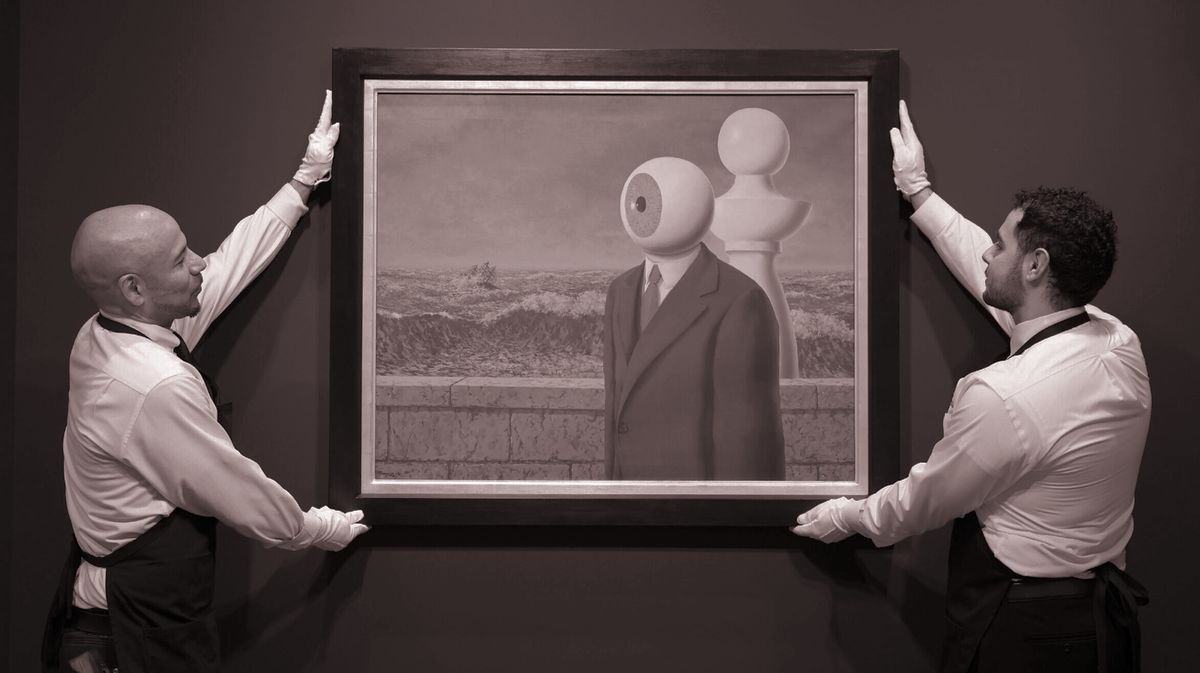
Picasso ($104 million), René Magritte ($102.5 million), Jean-Michel Basquiat ($101 million), Roy Lichtenstein ($71 million), Claude Monet ($70 million), Alberto Giacometti ($68 million), Alexander Calder ($57 million), Mark Rothko ($52 million), Piet Mondrian ($48 million), and Lucio Fontana ($44 million). The theme established here,
which continues down the list, is an emphasis on works by historically important artists. Although there are 11 living artists on the top 50 list—Gerhard Richter, Ed Ruscha, David Hockney, Richard Prince, Yoshitomo Nara, Marlene Dumas, Jenny Saville, George Condo, Georg Baselitz, Lisa Brice, and
Christopher Wool—they are in the minority, and several are quite advanced in years. |
|
|
A MESSAGE FROM OUR SPONSOR |
The first steps towards a masterpiece starts with a dream. The all-electric BMW i7 – the
evolution of brilliance. Learn more at BMWUSA.com |
|
|
There are 11 women on the list, including Yayoi Kusama ($23 million),
Georgia O’Keeffe ($19 million), Tamara de Lempicka ($19 million), Joan Mitchell ($17 million), Agnes Martin ($16 million), Marlene Dumas ($14 million), Jenny Saville ($13 million), Barbara Hepworth ($12 million), Helen Frankenthaler ($11 million), Lisa Brice ($10 million), and Remedios Varo ($10 million). That’s relatively good
news for the greater representation of women artists in the marketplace, but we’ve certainly seen times when it appeared that female artists were attracting more of the market’s attention.
Further underscoring the turn to historical artworks and artists, the list also includes Frantisek Kupka, M.F. Husain, Jean Arp, and Paul Delvaux, all 20th century artists we don’t normally see high in the auction volume tables. Of
course, supply plays a big role in the auction volume. So does the fact that sales are down across the board, allowing some of these artists to surface on a list like this. |
The top artist by maximum price was Mondrian, whose most valuable work auctioned in the
first six months of the year was $47.5 million. The remainder of the top 10 list are Monet ($43 million), Rothko ($38 million), Magritte ($35 million), Picasso ($28 million), Basquiat ($23 million), Giacometti ($18 million), Gerhard Richter ($15 million), Lucio Fontana ($14 million), and M.F. Husain ($14 million). Obviously, there are few very high-value works being sold these days. Still, these top prices generally map to the same group of artists who have the top auction volumes. Some notable
exceptions included Paul Signac ($8 million), Fernand Léger ($8 million), Clyfford Still ($7.5 million), Cecily Brown ($6 million), Simone Leigh ($6 million), Banksy ($5 million), Sigmar Polke ($5 million), and Lee Krasner ($5 million).
There were also significant Old Masters sales, though the top lot in those sales, a Canaletto that sold
for $41 million on July 1, was excluded from this first six months’ worth of data. Those strong Old Masters sales included Francesco Guardi ($10 million), Jan Davidsz. de Heem ($9 million), and Frans Hals ($8 million). Nothing speaks to the importance of art history better than strong Old Masters sales. |
New names emerge when we switch to the volume of lots sold by a particular artist in the first six
months of the year. Picasso, of course, was the highest-volume artist at auction by far, with 342 lots. Marc Chagall, whose market is strong and whose estate continues to be liquidated through Christie’s, was next with 83 lots. The numbers drop from there, starting with Andy Warhol at 66 lots, followed by Roy Lichtenstein, with 63 lots, whose estate is being liquidated through Sotheby’s. Isabelle de Borchgrave, who died last year, had 61 lots,
but her highest price was only in the mid-five figures.
Further down that list we see Damien Hirst with 43 lots, Christo and Jean-Claude with 43 lots, F.N. Souza with 35 lots, and Salvador Dalí with 32 lots. Auguste Rodin and César are also on the list, with 30 and 29 lots respectively, followed by David Roberts, an Old Master with 28 lots and total sales
of more than $1 million; Bernard Buffet with 26 lots; and a handful of Chinese classical painters like Zhang Daqian and Qi Baishi, as well as the Vietnamese painter Le Pho and the expatriate Chinese painter Zao Wou-Ki. Keith Haring, Wolf Kahn, Julian Opie, and Victor Vasarely are also on this list.
Naturally, the maximum
prices achieved, as well as the average values, vary widely here. Nevertheless, in a market characterized by growing strength at the bottom of the price range, this volume of transactions is notable. |
Finally, let’s look at aggregate hammer ratios. This list will have far more noise
in it than some of the others, because performance against estimates isn’t always an indication of market strength. But what looks like noise could also be early signals of market interest. We’ve taken the aggregate hammer price of all lots by an artist that were auctioned in the first half of 2025, and divided that number by the aggregate estimate. But let’s remember that estimates are merely marketing tools to attract bidders and communicate where the reserve price of an object might lie. The
list can be skewed by a single result, where there are only a few lots offered and one significantly outperforms. |
|
|
The list is also biased toward very low-value works, for which estimates can be easily exceeded
without spending much actual cash. For example, the top name on the list, with a hammer ratio of 7.76, is Georges Lemmen, a Belgian neo-impressionist painter, who saw one work estimated at $50,000 sell for almost $700,000 with fees. Five of the six Lemmen works offered in the first half of this year were sold, two of them for prices above the estimate. Whereas Wu Li, a 17th century Chinese landscape painter, had five works offered in the first half of the year,
all selling above their estimates, with three achieving hammer ratios of 3.75, 7, and 14.7, respectively—that last work sold for $360,000. Louis-Léopold Boilly had 20 works sell at auction in the first half of 2025, all of them at multiples of their estimates, ranging from 2 to 15, but none for more than $22,000, and the total for all 20 works was less than $190,000. S.H. Raza had eight works offered, six of which sold; the top work made $2.35 million against an
estimate of $300,000.
Mark Tansey’s results were bolstered by the strong performance of a single painting, Study for “The Enunciation,” which sold for $3.2 million, or more than eight times the estimate. Yu Nishimura had a rush of nine lots auctioned, and all but one sold for prices that were more than double the estimate, for a total of $1.7 million. Also on the list were Danielle McKinney, Mai Trung
Thu, Atsushi Kaga, Max Ernst, Tracey Emin, François Morellet, Mary Abbott, and Jean Arp. |
I’ve been writing about an historical turn to the market for some time. Although these
results definitely point to buyers seriously pursuing works made by historically significant artists—some living, many dead—it appears that we’re just at the beginning of the cycle. Buyers continue to pursue lower-value works at a fairly robust clip, and they’re not afraid to bid for the works they want—though we may not be seeing as many high-value purchases as we have in the past.
As we’ve discussed before, it seems likely those deals are happening in the private market, but we have no
way of verifying that. Nevertheless, the idea that buyers have lost interest in art doesn’t really make sense when you see this data. They’ve just turned their focus to undervalued works, and that longer-term project seems to be building momentum. |
I hope you found this helpful. See you again on Friday.
M |
|
|
The ultimate fashion industry bible, offering incisive reportage on all aspects of the business and its biggest
players. Anchored by preeminent fashion journalist Lauren Sherman, Line Sheet also features veteran reporter Rachel Strugatz, who delivers unparalleled intel on what’s happening in the beauty industry, and Sarah Shapiro, a longtime retail strategist who writes about e-commerce, brick-and-mortar, D.T.C., and more. |
|
|
Finally, a media podcast about what’s actually happening in the media—not the oversanitized,
legal-and-standards-approved version you read online. Join Dylan Byers, Puck’s veteran media reporter, as he sits down with TV personalities, moguls, pundits, and industry executives for raw, honest, sometimes salacious conversations about the business of media and its biggest egos. New episodes publish every Tuesday and Friday. |
|
|
Need help? Review our FAQ page or contact us for assistance. For brand partnerships, email ads@puck.news. You received this email because you signed up to receive emails from Puck, or as part of your Puck account associated with {{customer.email}}. To stop receiving this newsletter and/or manage all your email preferences, click here. |
Puck is published by Heat Media LLC. 107 Greenwich St, New York, NY 10006 |
|
|
|