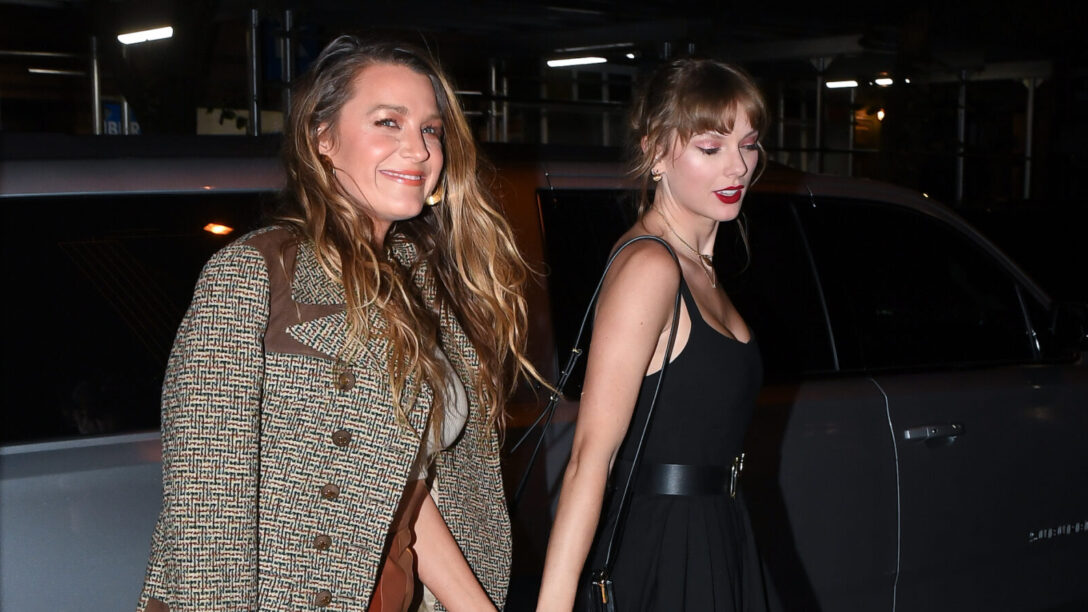

Perhaps it was inevitable that Taylor Swift would be pulled into the legal slugfest between Blake Lively and Justin Baldoni. Both sides understand the power of public perception—which, of course, includes the millions of Swifties who would walk barefoot across broken glass for the world’s most bankable pop star. The moment Swift became even tangentially connected to the mess over It Ends With Us, her ticket to deposition-ville was all but punched.
But who could have predicted the spectacle that unfolded this past week? According to an affidavit by Bryan Freedman, Baldoni’s attorney, a confidential source claims that on February 14—the day after the Super Bowl, where Lively was notably absent from her friend Swift’s V.I.P. box—Lively’s lawyer Michael Gottlieb called Swift’s counsel, J. Douglas Baldridge, and delivered an ultimatum: Issue a public statement of support for Lively, or risk the release of a decade’s worth of private texts between the stars. Baldridge allegedly accused Gottlieb of extortion and hung up. Gottlieb, naturally, has flatly denied saying any such thing. U.S. District Judge Lewis Liman was unamused by Freedman’s filing, slapping it down as “transparently invit[ing] a press uproar.” End of story? Not exactly.
Sure, Freedman may have pounced quickly—both with the filing and, perhaps, with the Daily Mail reporters on speed dial—but, curiously, Swift’s camp hasn’t publicly denied the exchange. Baldridge is fighting a subpoena, which has triggered a whole separate legal proceeding in Washington, D.C. And if the facts land anywhere near Freedman’s version, we could be in for a very interesting discovery phase—one that might result in Baldoni’s legal team eventually asking for sanctions.
Meanwhile, the gossip industrial complex is shifting into high gear on fresh whispers of a Lively-Swift falling-out—and Lively’s team appears acutely aware of the risk of losing the hearts and minds of Swift Nation. In turn, expect them to spotlight the shadowy presence of Swift’s longtime nemesis Scooter Braun in the Lively-Baldoni drama. After all, Braun’s Hybe agency owns Melissa Nathan’s P.R. shop, The Agency Group, which has been backing Baldoni. The Agency Group, according to court documents, once floated the idea of “planting stories about the weaponization of feminism,” and how women in Lively’s orbit—“like Taylor Swift”—allegedly use their influence to bully others into submission.
Whether Braun is actually involved is unclear. (Ironically, he’s personally represented not by Nathan, but by Stephanie Jones, who is suing Baldoni.) But if Team Lively wants to retaliate for this week’s stunt, a subpoena to Braun could be in the cards. That, of course, would ignite another tabloid firestorm. For now, Gottlieb has asked Judge Liman to punish Freedman for his outspokenness and unsubstantiated accusations throughout the case.
Will any of this matter at an actual trial? That remains to be seen. But with at least 10 months to go, both sides seem determined to make the litigation process as punishing as possible. A settlement would, on paper, make sense. From what I hear, though, no one’s picking up the phone.
Swifties Stumble
Baldonigate wasn’t the only ripple in the Taylor Swift universe last week. There was the curious case of the human remains discovered near her Rhode Island compound, as well as Donald Trump posting on Truth Social that she’s no longer “hot.” And then there was the legal setback for Swifties who attempted to sue Live Nation over the ticketing debacle that marred the start of the Eras Tour.
The 2023 fiasco, you will recall, reignited scrutiny of the 2010 Live Nation–Ticketmaster merger, and arguably helped nudge the Department of Justice toward its current effort to break up the concert giant. But last Wednesday, U.S. District Court Judge George Wu tossed out large portions of the antitrust, contract, and fraud claims, leaving the entire suit perilously close to being declared a loser.
However that turns out, the more pressing case for Live Nation is a longer-running consumer class action before Judge Wu, which is quietly gaining steam: Skot Heckman, et al. v. Live Nation, which recently survived a motion to dismiss and has now drawn the attention of the U.S. Supreme Court. Just a few days ago, the justices signaled interest in the case—an early procedural nod that could carry implications for not just Live Nation, but Fox, Warner Bros. Discovery, Disney, and other entertainment heavyweights.
Back in 2020, a separate group of consumers, fronted by Mitch Oberstein and led by lawyers at Quinn Emanuel and attorney Warren Postman, attempted to launch a case against Live Nation for alleged anticompetitive practices. The roadblock? The fine print on Ticketmaster’s website, which forces aggrieved ticket buyers into binding arbitration. This stalled the case, and so Postman launched a barrage of thousands of individual arbitration demands—a tactic he pioneered—each one triggering upfront legal fees for corporate defendants. For companies like Live Nation, the financial exposure ballooned into the tens of millions.
With no clear off-ramp other than settling, companies began describing the mass-arbitration racket as a form of legalized extortion. Some businesses, most notably Amazon and TikTok, very quietly revised their terms of service—moving away from arbitration, and steering future disputes back into the court system. Others fought fire with fire: Fox, facing arbitration demands tied to allegedly discriminatory advertising on its Tubi streaming service, sued Postman’s firm outright—accusing it of interfering with contractual relationships and demanding that the lawyers behind the campaign be forced to withdraw.
Live Nation, meanwhile, took a different approach. It ditched JAMS—the long-established arbitration forum that demanded hefty up-front fees—and directed disgruntled ticket buyers to a new venue: New Era ADR, a Chicago-based upstart founded in 2020. New Era marketed itself as a faster, more corporate-friendly alternative, offering streamlined procedures that included annual subscriptions instead of per-case fees, the ability to “batch” similar claims, and a novel twist: the use of so-called “bellwether cases,” handpicked from the batch and used to set precedent for the rest—even for cases that hadn’t yet been filed.
In practical terms, this means that if you ever have a grievance with Ticketmaster, you may find your claim was already effectively decided—by a confidential ruling, in a private forum, applying to a case you were never part of. That’s precisely where the Heckman case comes into play. In this antitrust suit against Live Nation, the legal teams from Quinn Emanuel and Keller Postman are back, and have successfully dodged arbitration because Judge Wu found Live Nation’s revised arbitration agreement to be both unconscionable and a violation of California law. Last October, the 9th U.S. Circuit Court of Appeals upheld that decision, pointedly noting, “It is clear that Congress did not have class-wide arbitration in mind when it passed the FAA,” referring to the Federal Arbitration Act, enacted in 1925.
Now, Live Nation wants the Supreme Court to weigh in. Its lawyers at Latham & Watkins argue that a century ago, Congress intended the FAA to safeguard all private dispute resolution, regardless of whether states like California approve of the details. Live Nation says state interference undermines the federal policy favoring arbitration agreements, and they shouldn’t meddle with companies’ efforts to combat what they consider abusive tactics from entrepreneurial plaintiffs’ lawyers. Live Nation is urging the justices to “right the ship.”
Heckman’s lawyers initially waived their right to respond to the petition. That’s common, especially when the expectation is that the Supreme Court won’t bite. Why bother dignifying a long-shot appeal? But on May 13, the justices requested a response. It’s due next month, and may raise a provocative issue: Can corporations rig the arbitration process in their favor, essentially having their cake and eating it, too?
It’s not just Live Nation and New Era that have been experimenting with bespoke arbitration forums. Warner Bros. Discovery, for instance, quietly revised its terms of service during the HBO Max rebrand to route disputes through NAM, another upstart. Whether these hand-picked, corporate-friendly forums can withstand legal scrutiny is a big question. The entire consumer arbitration arena seems to be facing a stress test.
The D.O.J. v. Live Nation
As the Supreme Court gets ready to decide whether Heckman is worth its attention, the case is winding its way through a lower federal court in Los Angeles, where Judge Wu rejected Live Nation’s motion to dismiss last month. (Here’s the ruling.) So why is Heckman moving forward while the Swifties hit a wall? In short: clarity. Heckman presents a more straightforward legal theory, one that draws a clean line between Live Nation’s control over Ticketmaster and concert venues, and the anticompetitive practices that allegedly lead to higher fees for consumers. The Swifties, by contrast, have struggled to untangle the messier dynamics behind the Eras Tour ticketing debacle, making it harder to pin down a coherent legal claim.
Now that the case is proceeding, Heckman’s legal team is gaining access to much of the same information that’s been shared with the Department of Justice. In fact, Heckman could turn into a kind of companion piece to the D.O.J.’s sprawling effort to break up Live Nation and Ticketmaster. The government action is backed by 29 states, and if Heckman is certified as a class action, it would proceed on behalf of consumers in all 50 states and go before a jury, likely in 2027. Its scope may also be broader, targeting not just the primary ticketing market, but the secondary one, too.
But with the D.O.J. likely going first, Heckman’s lawyers will be watching closely—cherry-picking the best witnesses, testing the jury pool, and drafting their closing arguments accordingly. The financial stakes are potentially massive. If the government succeeds in proving anticompetitive conduct, Heckman could blow the doors wide open by potentially exposing Live Nation to a massive bill. (Remember: Successful antitrust plaintiffs are entitled to treble damages.) Of course, Live Nation may very well triumphantly defend its business model. But it’s all getting trickier now that the concert giant faces the prospect of a pair of bicoastal trials.