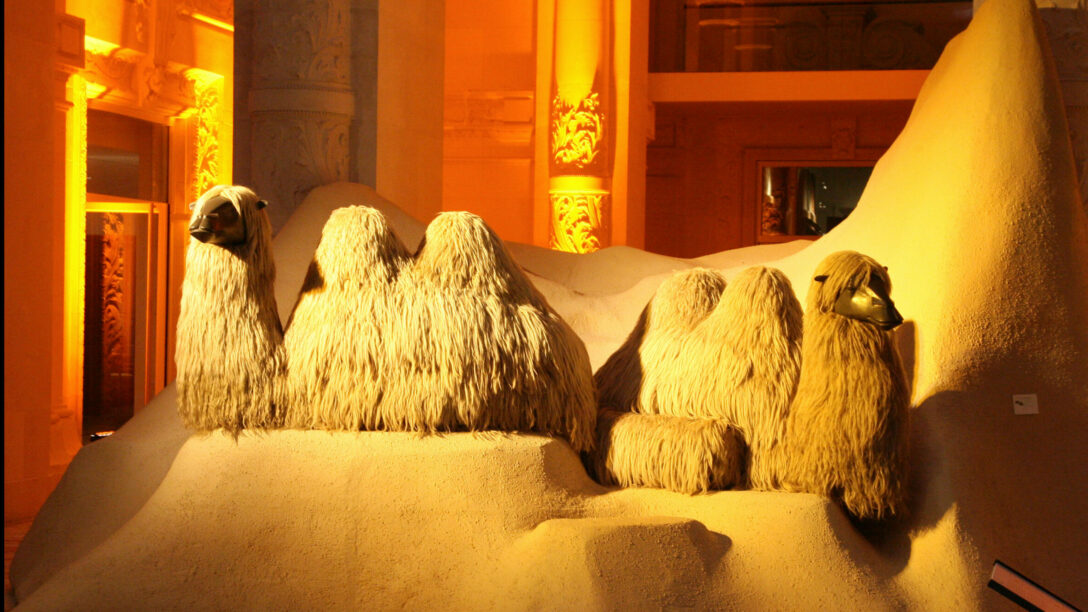

This fall, in Christie’s November auctions, one of the lots will be a historic piece of furniture—or sculpture, depending upon your point of view—depicting two camels, complete with shaggy fur, that function as couches. The hybrid, hard-to-define work was made by François-Xavier Lalanne. He and his wife, Claude Lalanne, are the surrealist-inspired duo whose oversize, animal and vegetal objets have become some of the most sought-after works in the art market.
The pair of camels, which are two of only four ever made, carry an estimate of $4 million. Yet that number hardly even touches the levels at which work by “Les Lalanne,” as they are collectively known to the art world, can reach. Yes, the Sydell Miller estate, which will be sold at Sotheby’s in November, includes a Lalanne elephant table also estimated at $4 million. But a companion table, offered by Christie’s with the same estimate in 2021, sold for $6.6 million. The Lalanne camels, which were last shown in public at a seminal exhibition organized by Peter Marino at the Musée des Arts Décoratifs, in 2010, will almost certainly blow past estimates, too.
A year ago, Christie’s offered a rare example of a large secretary desk, shaped like a Rhinoceros, in a single-lot evening sale in Paris. Estimated at €4 million, the work had appeared in that same 2010 Parisian exhibition as the camels. The night of the sale, the bidding on the early, unique work—which had been held in the same family for more than half a century—overshot the estimates to land at €18.33 million ($19.4 million), or more than twice the previous record for the artist. The price seemed spectacular, but works by Les Lalanne are no stranger to making an impact at auction.
The Lalanne Bounce
In the depths of the global financial crisis, in 2009, Christie’s held the sale of works owned by Yves Saint Laurent and Pierre Bergé, which included several important Lalanne works as would befit the couple’s early patron. As the banking system teetered on the edge of armageddon, rich people were happy to fling their presumably much-needed cash at a wide range of art and decorative objects owned by the legendary designer and his mastermind partner. Carla Fendi was one of them. She bought François-Xavier’s custom-made Bar YSL, which was estimated at a reasonable €200,000, for a stunning €2.75 million ($3.5 million), which would be $5.22 million today, adjusted for inflation.
And the market for work by Claude and François-Xavier Lalanne has more than kept pace with inflation. According to Ben Brown, prices for Lalanne works were doubling every two years from 2015 to 2022. Brown should know: With his galleries in London and Hong Kong, along with Galerie Mitterrand in Paris and Kasmin in New York, Brown has been an essential market-maker in works by the late French couple. Currently, he has an installation of Lalanne works at a palazzo in Venice. Dubbed Planète Lalanne, the show includes nearly 125 different works across eight rooms, ranging from major pieces like the bronze Hippopotamus II bar (another example in the series sold for $7.5 million in May 2023) to one of Claude’s signature Choupattes, a large cabbage standing on chicken feet.
By his own admission, Brown spent a fortune staging his Lalanne show in Venice. But it is the kind of opulent setting that Brown felt was the last missing piece from the jigsaw puzzle of the Lalanne market. Timed to coincide with the Venice biennale, the show opened in April and will last until November. “This show is effective because extremely important collectors came and bought,” Brown said. “This show is part of the reason for the demand.”
Four Daughters
Brown and I got to discussing the curious nature of the Lalanne market. After the YSL-Bergé sale, there was an increased appreciation for—and visibility of—the couple’s work, especially the stone sheep which act as market bellwethers due to the large editions in which they were made. Currently, Lalanne stone sheep trade for prices around half a million dollars. (Lalanne dealers will often step in to buy ones at auction that fall below the market price.) But Brown says he only gets his hands on maybe one in five sheep that come to auction—a sign of strength in the market. “I am absolutely delighted,” he told me, “when I get nothing.”
Much of that stronger demand has manifested in the last five years, following the death of Claude Lalanne, in 2019, at the age of 94. (François-Xavier died more than decade earlier, in 2008.) In some ways, this dynamic has been counterintuitive. When Claude passed, the Lalanne estate was inherited by the couple’s four daughters. The estate put a large number of works up for auction—and important works were donated to French museums. Then two of the daughters began to sell through the auction houses. Ordinarily, such a volume of sales might have suppressed the market.
Instead, it has grown stronger. The first sale, with Sotheby’s in October 2019, made a whopping €91 million—a portion of which went toward settling the estate’s tax obligations. That allowed the Lalannes’ daughters to divide the rest of the seemingly boundless trove of objects stored at Les Lalanne’s farm in Ury, outside of Paris. Two years later, buoyed by the success of the sale, one of the daughters, Dorothée, held two auctions at Sotheby’s, making an additional €129 million. The next year, Marie Lalanne, another of the daughters, held a sale at Christie’s that netted €77 million. Now, on October 10 in New York, Dorothée will sell at Christie’s an additional 70 lots in a rare sale that focuses only on François-Xavier’s works. Christie’s wants to put the spotlight on his work as a sculptor. And though the Lalannes were an artistic team, they rarely collaborated on works. The sale will have a low estimate of $16 million.
Don’t pay too much attention to the estimates. One of the peculiarities of the Lalanne market is that almost everything sells for higher prices. That’s mostly because the consignors can keep the estimates low, feeling confident that the market will absorb the work. Even non-estate sellers like Pauline Karpidas, who sold the contents of her home on the island of Hydra at Sotheby’s last year, had gotten the memo. The Lalanne estimates were all easily surpassed in the sale.
In situations like this, there is usually a great deal of friction between the galleries that represent an artist and the auction houses that are often competing for the same material. Right now, however, the Lalanne market continues to expand. That’s good for Brown. He believes Dorothée’s upcoming Christie’s sale has good things in it. For example, the Trés Grand Ours is estimated at $2 million, even though a version of the bear two-thirds its size sold at Christie’s two years ago for $3.66 million. Or this bronze Belier that is estimated at $400,000, even though three other examples of the work have sold in the last three years for prices ranging from double to triple that estimate. Good things at seemingly low prices are exactly what make the auctions work.